This is a researched travel plan. I have not visited Ueda or Bessho Onsen; I have worked out this itinerary as though I were preparing to go. Prices and opening information were checked in September 2026. Please check the relevant official websites for the latest details before travelling.
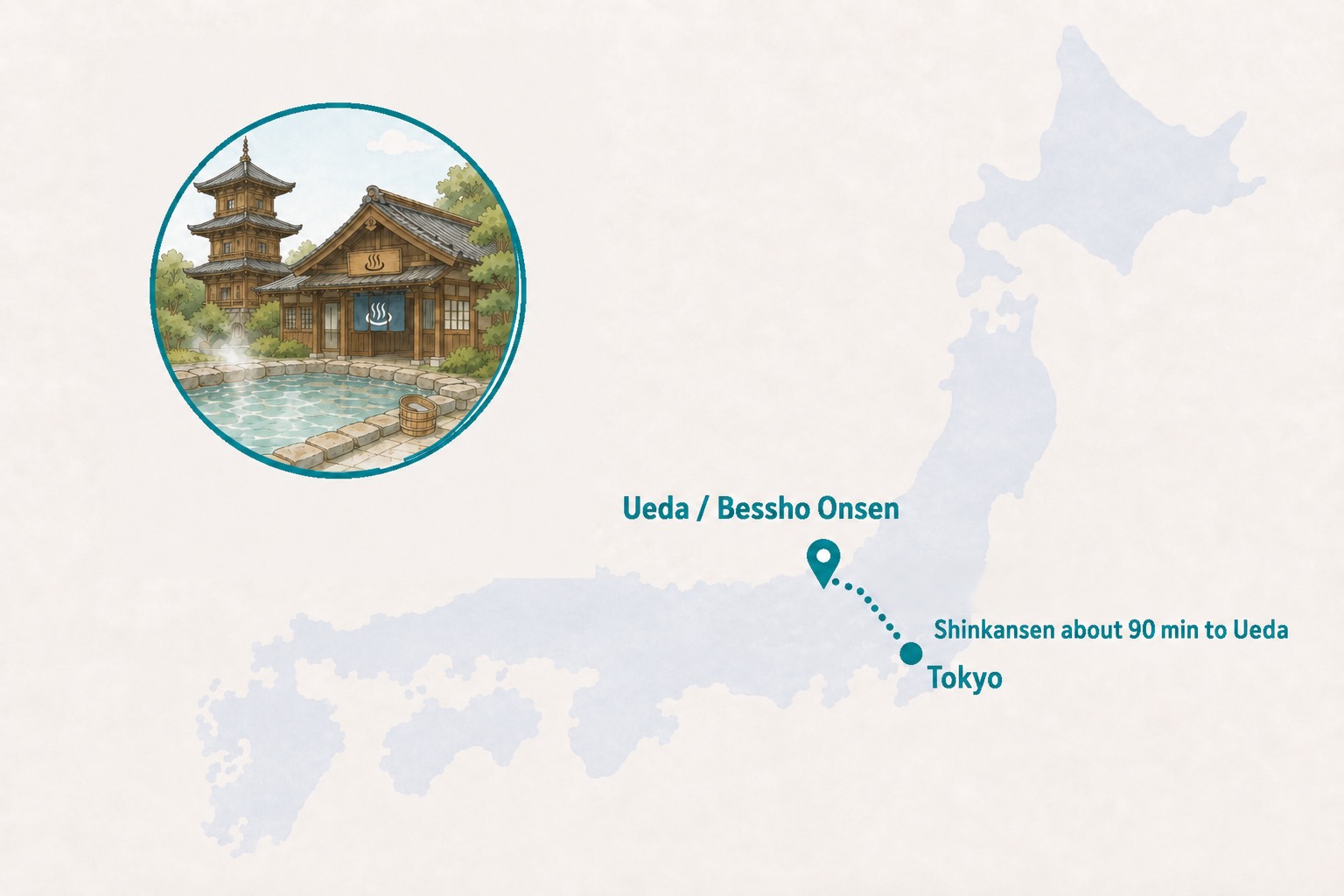
The plan at a glance
- Length: two days, one night, travelling from Tokyo by Hokuriku Shinkansen
- Destination: Bessho Onsen in Ueda, Nagano Prefecture, plus the area around Ueda Station
- Day 1: Tokyo → Ueda → Ueda Castle Park and Shinshu soba for lunch → the Bessho Line to Bessho Onsen → a public bath → a night at a hot spring inn
- Day 2: Kitamuki Kannon and the National Treasure octagonal pagoda at Anrakuji → another public bath → back to Ueda for the journey home
- When I would go: April is a possibility for cherry blossoms, though the timing of flowering and peak bloom varies each year
- Estimated cost: ¥45,880, or about ¥46,000 per person, assuming two adults share a room with dinner and breakfast included
- For two people: ¥91,760, putting the trip for a couple at close to ¥100,000. The per-person figure is a share of the cost for two adults sharing a room, not a solo travel price.
Why Ueda and Bessho Onsen?
After Tomonoura, Bessho Onsen was the second place that caught my attention while researching where a travel budget could take me.
With its many temples, it is known as the “Kamakura of Shinshu”. Shinshu is an older regional name for Nagano, and Bessho Onsen is said to be its oldest hot spring resort. As someone interested in Japan's Warring States period, I am drawn to Ishiyu, a public bath reputed to have been a secret bathing place of the Sanada clan. It is associated with Shotaro Ikenami's historical novel Sanada Taiheiki, too.
The other surprise was the journey. Tokyo to Ueda takes about 90 minutes by Hokuriku Shinkansen; reaching Bessho Onsen then takes another 30 minutes or so on the Bessho Line, plus the wait for a connection. With Tomonoura, I had assumed the distance would put it out of reach until I did the sums. Here, I was left wondering why I had never gone. Living in the Kanto region, I tend to associate Nagano with day trips for skiing. An overnight hot spring trip had somehow escaped that picture.
Getting there
- Tokyo → Ueda: about 90 minutes on a Hokuriku Shinkansen Hakutaka or Asama, depending on the train. An adult paper ticket in the regular season costs ¥6,900 one way, including the base fare and the ordinary-class reserved-seat Shinkansen surcharge. The faster Kagayaki service does not stop at Ueda.
- Ueda → Bessho Onsen: about 30 minutes on the Ueda Dentetsu Bessho Line; ¥590 one way or ¥1,180 return for an adult. There are generally one or two trains an hour during much of the daytime, but some gaps approach an hour. Allow for the connection from the Shinkansen and check the official timetable for the day of travel.
The Bessho Line is a local private railway known for its round-window trains. A ride through farmland with a hot spring town at the end sounds like part of the day's sightseeing in its own right.
The main budget below uses the regular, undiscounted Shinkansen fare. Eki-net's Tokudane 14 discount ends with travel on September 30, 2026, so I have kept that calculation in a separate, time-limited reference case.
A two-day, one-night itinerary
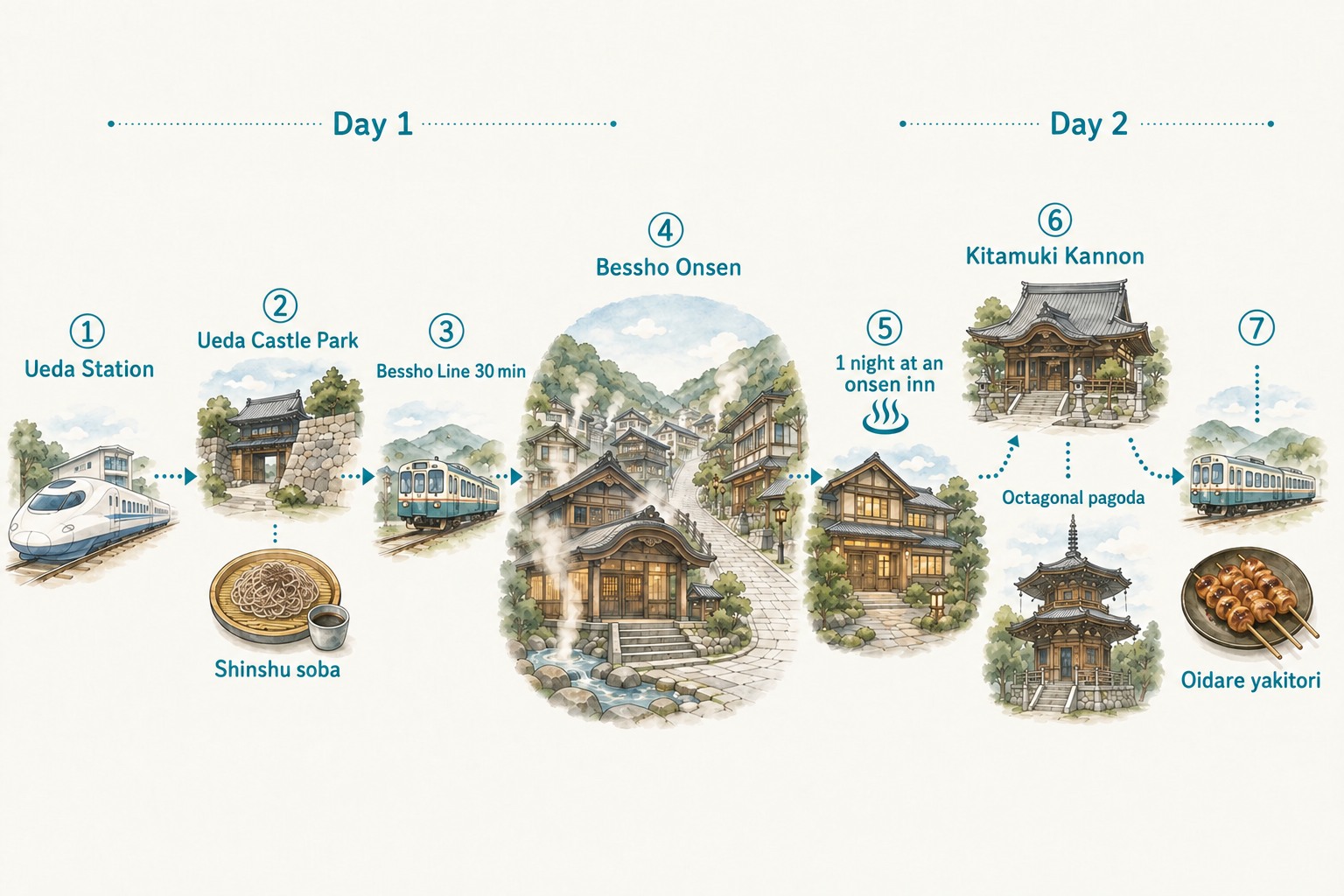
The timings below are a guide, to be fitted around the chosen Shinkansen and Bessho Line connections. I have not confirmed a restaurant serving oidare yakitori at lunchtime, so that remains a possibility rather than a fixed meal stop.
Day 1: Sanada history in Ueda, then on to the baths
I would look for a train leaving Tokyo between 9 and 10 a.m., then plan the morning around its arrival in Ueda. Departures within that hour do not all arrive at the same time. The walk and lunch would fit around the train, using the time before check-in to explore Ueda.
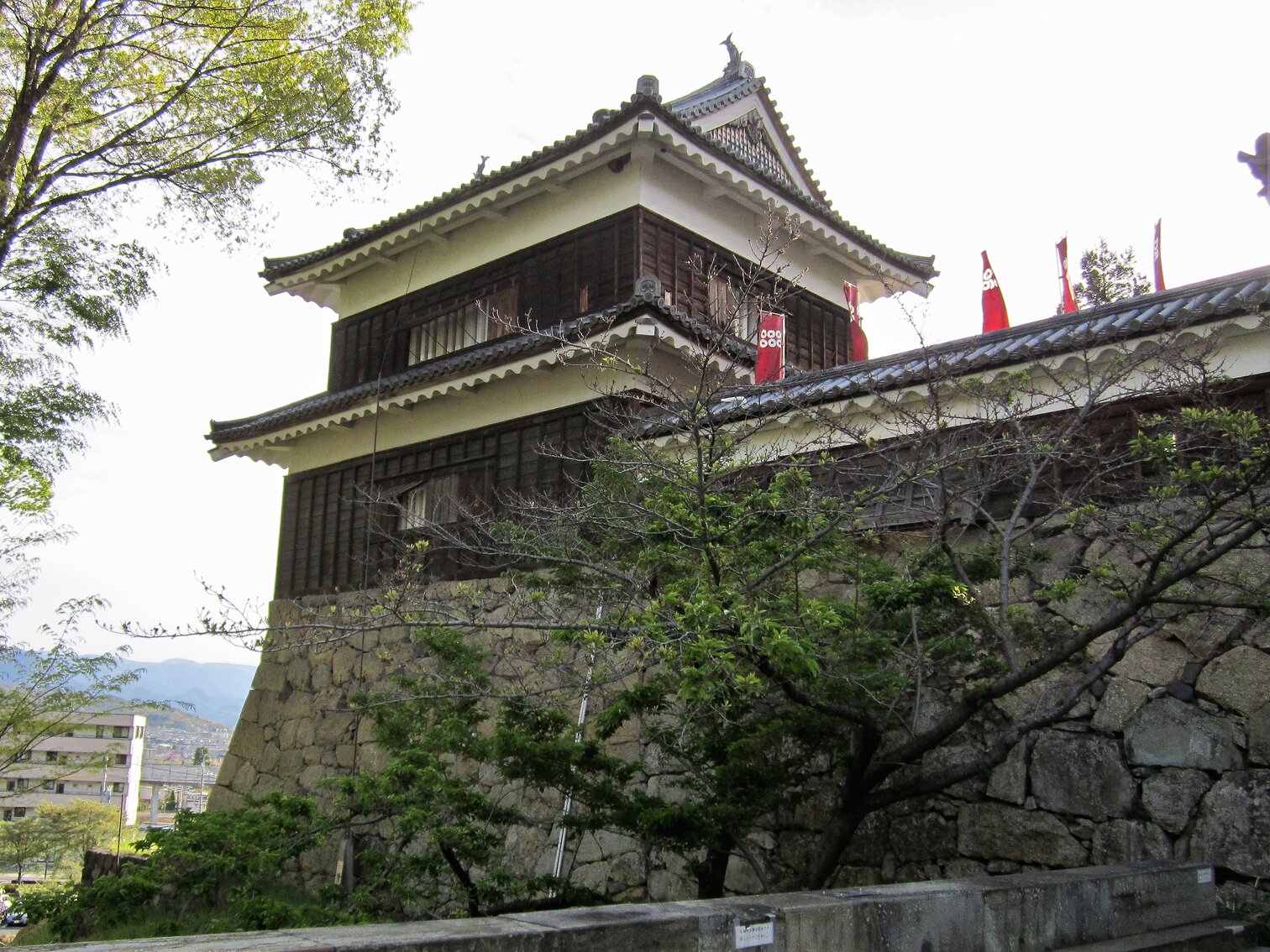
Ueda Castle Park is within walking distance of the station. Sanada Masayuki built the castle, which twice held off the Tokugawa army. The park grounds are free to walk around; admission to the turrets, museum and other paid facilities is separate. A walk here should fit the available time, followed by Shinshu soba near the station for lunch. Some paths may be restricted during improvement work, so I would check Ueda City's park information before visiting.
In the afternoon, I would take the Bessho Line to its terminus at Bessho Onsen, leave my bags at the inn and head out for a bath.
There are three public bathhouses, each charging ¥300 per adult per visit:
- Ishiyu: reputed to have been a secret bath of the Sanada clan and associated with Sanada Taiheiki. Open 6:30 a.m.–9:30 p.m., last admission 9 p.m.; normally closed on Tuesdays.
- Daishiyu: said to have been a favourite bath of the monk Jikaku Daishi in the Heian period. Open 6 a.m.–9 p.m., last admission 8:30 p.m.; normally closed on Thursdays.
- Oyu: associated with Kiso Yoshinaka, and the only one of the three with an open-air bath. Open 6:30 a.m.–9:30 p.m., last admission 9 p.m.; normally closed on Wednesdays.
The prices and last-admission times come from the official revision effective April 1, 2025. Temporary closures and holiday changes are possible; check the latest information for each bathhouse before the trip.
I would start with Ishiyu, once I had checked its opening day, then spend the evening at the inn over a kaiseki dinner and a soak in its indoor bath.
One lodging option that interests me is Ryokan Hanaya. It is a Registered Tangible Cultural Property built by craftsmen specialising in temples and shrines, with Taisho-style stained glass and a marble bath said to have continuously flowing hot spring water. It is about five minutes on foot from Bessho Onsen Station. For a solo trip, Uematsuya also looks worth considering, as it explicitly welcomes solo travellers.
For this budget, though, I am assuming ¥25,000 per person for two adults sharing one room, with dinner and breakfast included. That is a planning allowance for the chosen inn, not an area-wide average or a price guaranteed for every date. The travel date, day of the week, room and package all affect the rate. A solo room price would need to be checked separately.
Day 2: morning temple visits and one more bath
The morning would begin at Kitamuki Kannon in the centre of the hot spring town. The temple faces north towards Zenkoji; visiting only Zenkoji is traditionally described as making just half of the paired pilgrimage. An ordinary visit for worship is free, but charges for special visits or events need to be checked separately.
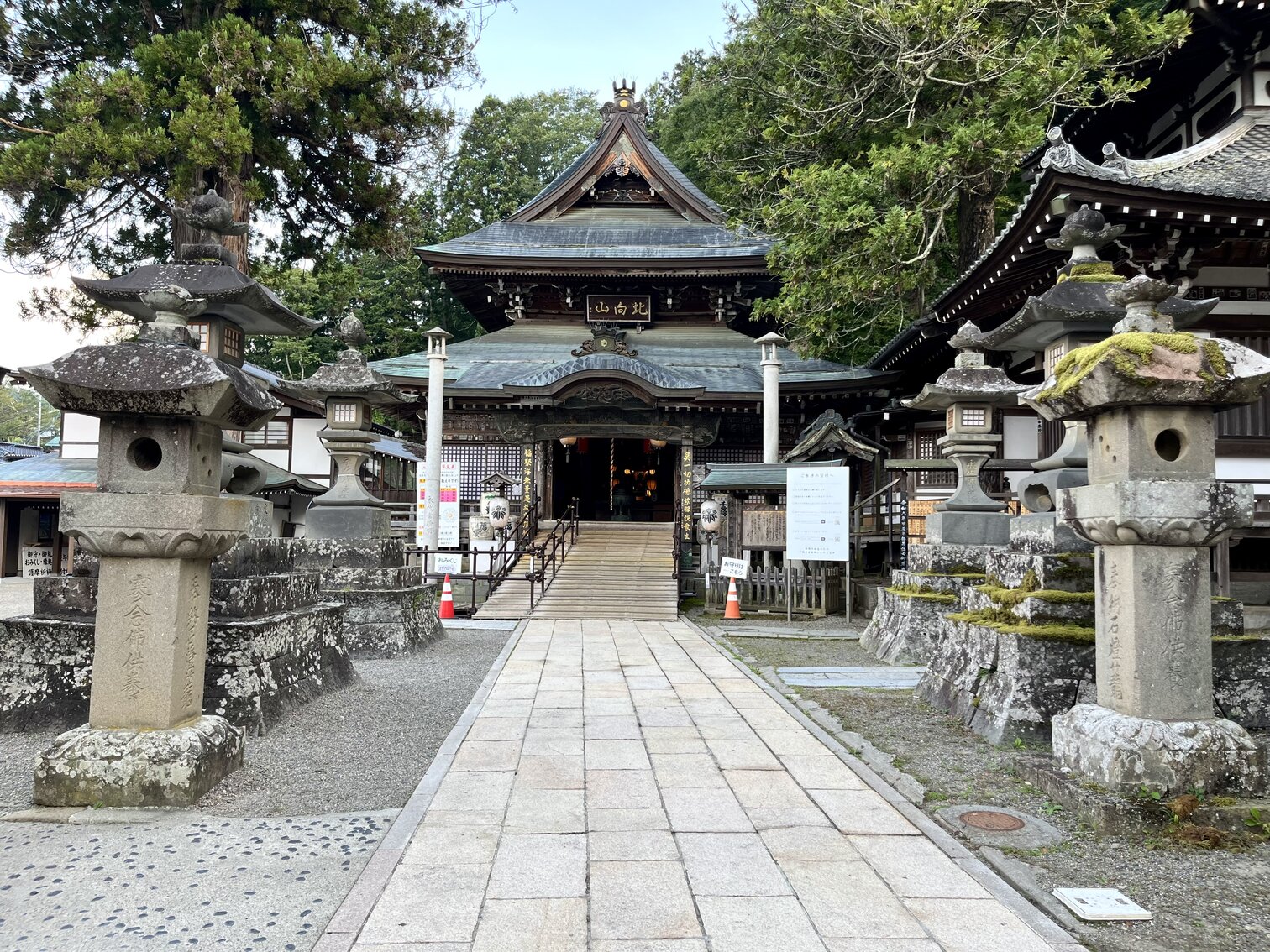
From there, I would walk uphill to Anrakuji, arriving no earlier than its 8 a.m. opening. Its octagonal three-storey pagoda is a National Treasure. From what I have read, virtually no other octagonal pagodas survive in Japan. This may be the sight I most want to see on the trip.
Anrakuji's official visitor information lists adult admission at ¥300. From March to October, opening hours are 8 a.m.–5 p.m., with last admission at 4:45 p.m. From November to February, opening hours are 8 a.m.–4 p.m., with last admission at 3:45 p.m. I would fit the morning around the 8 a.m. opening and check for changes due to events or other circumstances.
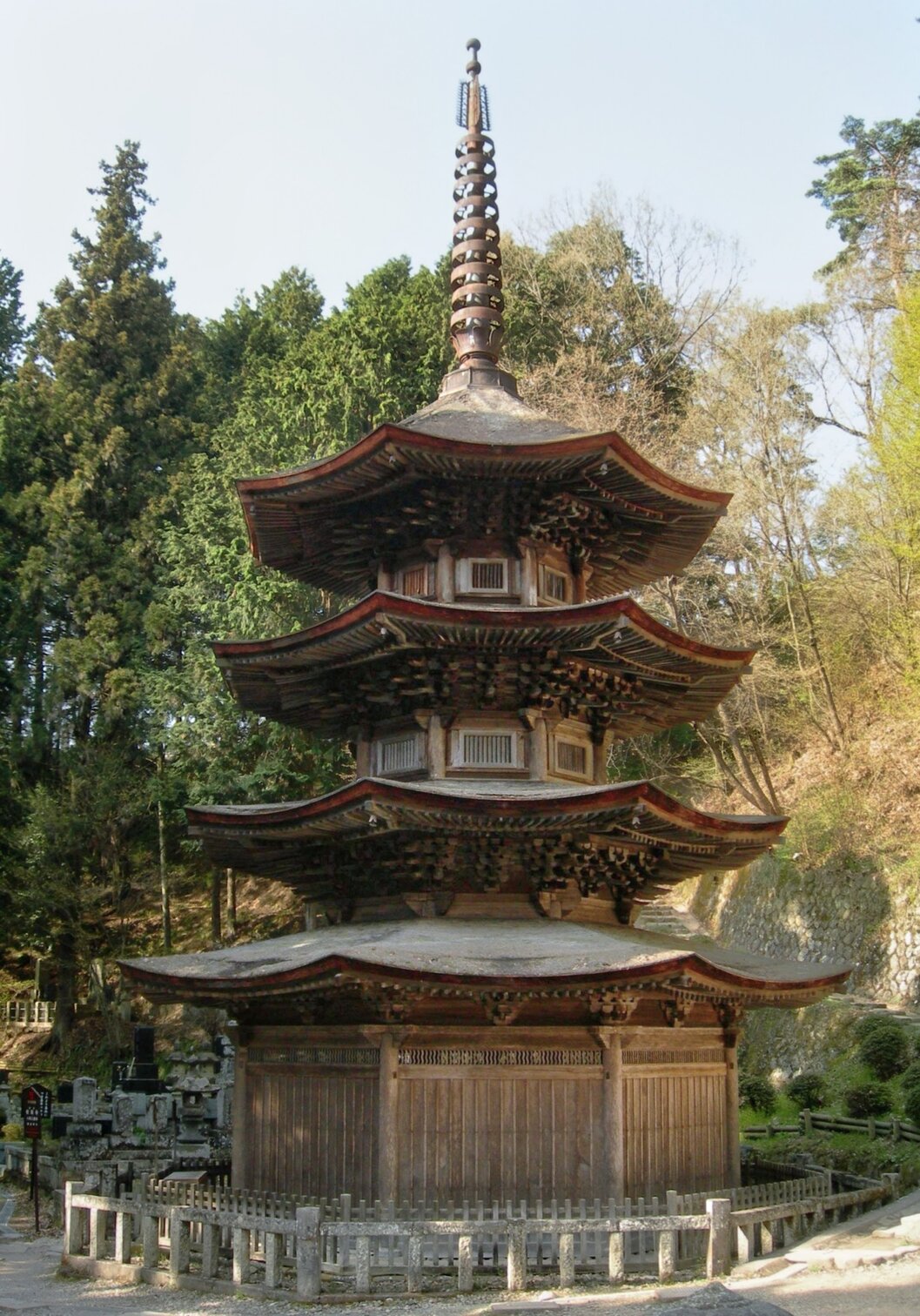
After checking out, I would take one more bath at Oyu or Daishiyu, depending on which is open, then aim for a Bessho Line train back to Ueda in the early afternoon.
I would like to try the local oidare yakitori, grilled chicken served with a soy-based sauce containing grated garlic, if I can confirm somewhere serving it at lunchtime. I have not yet identified a specific restaurant open for lunch. The plan is to take a Shinkansen home before evening, but the arrival time in Tokyo depends on that train and the connection from the Bessho Line. I would check both timetables for the return date before settling the schedule.
Estimated cost per person, with two adults sharing a room
The regular-fare calculation is for two adults staying in one room. Each figure below is one person's share.
- Shinkansen, Tokyo ⇔ Ueda: ¥13,800 return, or two ¥6,900 one-way adult paper tickets in the regular season, including the base fare and ordinary-class reserved-seat Shinkansen surcharge
- Bessho Line, Ueda ⇔ Bessho Onsen: ¥1,180 return, or two ¥590 adult fares
- Accommodation: ¥25,000, the assumed per-person cost of sharing one room with dinner and breakfast included
- Baths and admission: two public baths at ¥300 each, plus ¥300 for Anrakuji, totalling ¥900
- Food, covering two lunches, and incidental expenses: ¥5,000, including ¥150 bathing tax and ¥200 accommodation tax
The calculation uses a bathing tax of ¥150 per person per night and an accommodation tax of ¥200 per person per night. Both taxes, ¥350 in total, are already included in the ¥5,000 food and incidental allowance; they are not added again. The ¥200 accommodation tax rate applies from the scheme's introduction on June 1, 2026 through May 31, 2029.
¥13,800 + ¥1,180 + ¥25,000 + ¥900 + ¥5,000 = ¥45,880 per person, or about ¥46,000. For two adults, that is ¥91,760.
That comes to nearly ¥30,000 less per person than the roughly ¥74,000 Tomonoura plan. The shorter distance shows up in the Shinkansen bill. Starting with a budget of ¥100,000 for one person, these assumptions would instead cover a trip for a couple: close to ¥100,000 for two.
Transport, bath and admission prices and tax rates reflect the information checked in September 2026. Accommodation, food and incidental expenses are planning assumptions. Room prices vary by travel date, day of the week, room and package, so these figures cannot be used as a solo travel estimate.
Time-limited reference case: Tokudane 14, for travel through September 30, 2026 only
For the Tokyo ⇔ Ueda section on Asama services, the Shinkansen e-ticket Tokudane 14 fare is ¥4,680 one way for an adult ordinary-class reserved seat, or ¥9,360 return. It is limited to specified trains and sections, with a restricted number of seats. Booking is required by 11:50 p.m. Japan time, 14 days before each travel date. Discounted seats on the trains you want are not guaranteed.
The offer ends with travel on September 30, 2026 and cannot be used for journeys on or after October 1, 2026. Only if both legs fall on eligible trains by September 30, 2026 and discounted seats are secured for both, with all other assumptions unchanged, does the calculation become:
¥9,360 + ¥1,180 + ¥25,000 + ¥900 + ¥5,000 = ¥41,440 per person, or ¥82,880 for two adults.
The total in the ¥80,000s for two belongs only to this dated, conditional example. It is not the regular budget or an ongoing way to save on a future trip.
When would I go?
Ueda Castle Park, the first day's walking stop, is known for around 1,000 cherry trees. April would be a possibility, but flowering and peak bloom shift from year to year; early April does not guarantee full bloom.
The 2026 Ueda Castle Senbonzakura Festival ran from April 4 to 12, 2026, with evening illuminations also advertised that year. The 2026 festival has finished. I would check official announcements for the next festival's dates and programme, along with the flowering reports, before choosing travel dates. If the blossoms line up with the trip, the castle walk becomes a chance for cherry-blossom viewing too. I would expect crowds.
What I still do not know
There is one gap in the research I want to leave visible:
- Oidare yakitori at lunchtime. I associate it with evening izakaya menus and have not confirmed somewhere serving it for lunch.
If I get to make the trip, I would like to revisit that question in a follow-up comparing the plan with what actually happened.
Would the budget work?
About 90 minutes by Shinkansen from Tokyo to Ueda, then about 30 minutes on the Bessho Line to Bessho Onsen. The full journey also needs time for the connection and varies with the trains chosen. A ¥300 bath associated with the Sanada clan, a National Treasure pagoda, and the possibility of staying in an inn registered as a cultural property are enough to make me want to go.
Assuming ¥25,000 per person for one room shared by two adults, with dinner and breakfast, the total is ¥45,880 per person, about ¥46,000, or ¥91,760 for two. That puts a couple's overnight trip at close to ¥100,000.
I had filed Nagano away as somewhere for a day trip. Researching Bessho Onsen has made me think about staying the night. I can already picture taking the round-window train out to the hot spring town.
If I make it there, I will write about how the trip compares with this plan.
Photos from Wikimedia Commons: Ueda Castle South Turret (Suikotei / CC BY-SA 4.0); 別所温泉 北向観音 2024 (ほっきー / CC0); Anrakuji Hakkakusanjyuunotou BessyoOnsen (Rsa / CC BY-SA 3.0). All photographs have only been resized.


Estimated cost per person, with two adults sharing a room
- Shinkansen, Tokyo ⇔ Ueda, return: ¥13,800 for adult paper tickets in the regular season, including the base fare and ordinary-class reserved-seat Shinkansen surcharge
- Bessho Line, return: ¥1,180 per adult
- Accommodation with dinner and breakfast: assumed at ¥25,000 per person when two adults share a room; this is not a solo room rate
- Two public baths, ¥600, and Anrakuji admission, ¥300: ¥900
- Food, covering two lunches, and incidental expenses: ¥5,000, including ¥150 bathing tax and ¥200 accommodation tax
- Total: ¥45,880 per person, about ¥46,000, or ¥91,760 for two adults (close to ¥100,000 for a couple)