This is a desk-researched itinerary. I have never been to Oga or Akita. These are places I would like to go, researched and planned as seriously as if I were actually going. Prices and operating information were checked in September 2026, but please confirm the latest details on each official website before you travel.
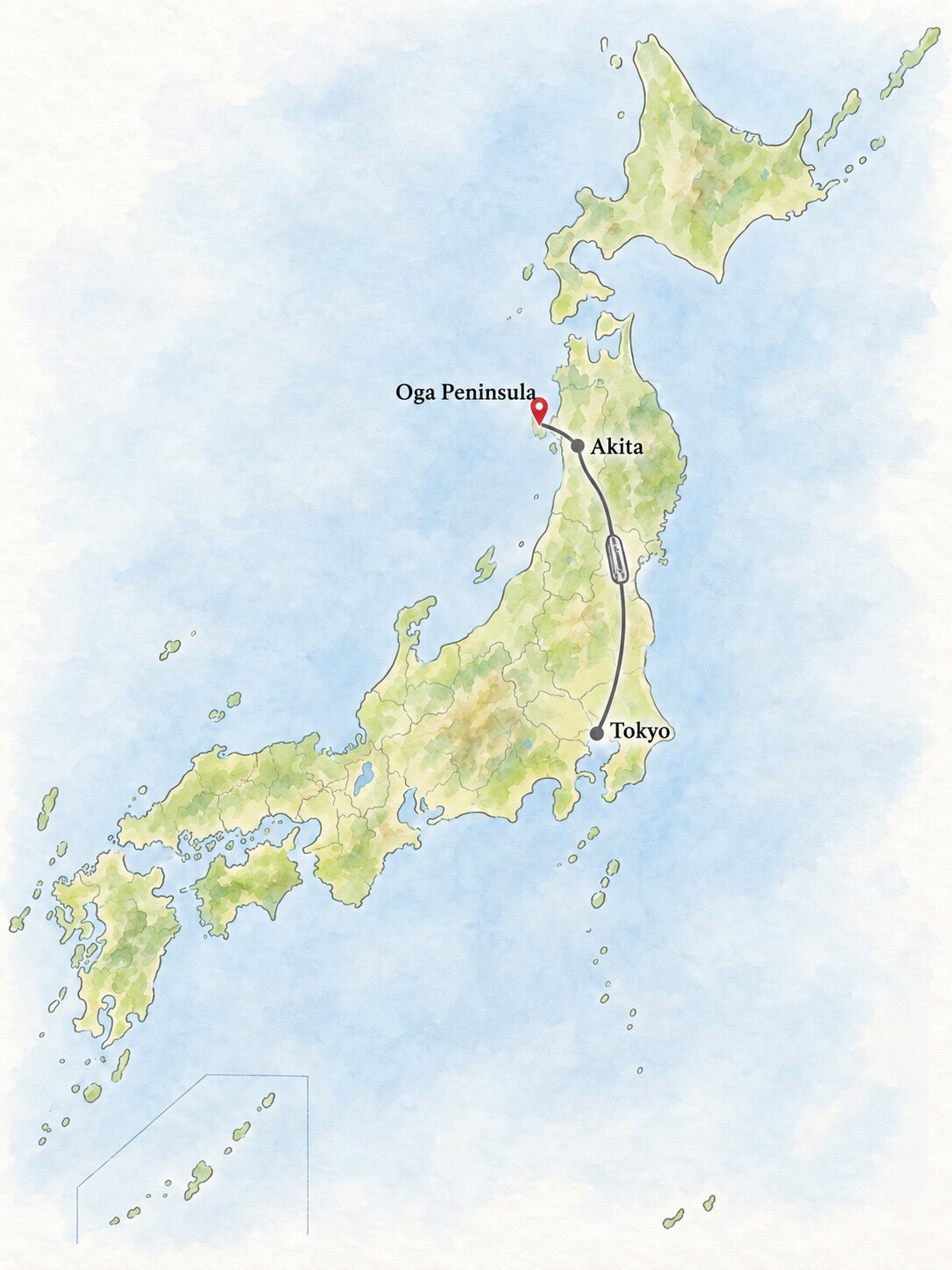
The plan at a glance
- Budget: ¥200,000 for two (¥100,000 per person), 3 days and 2 nights, from Tokyo
- Where: Akita Prefecture. One night in the Oga Onsen hot-spring area on the Oga Peninsula, one night in Akita City
- Day 1: the hydrangeas at Unshoji Temple, then on to Oga Onsen. Day 2: Cape Nyudozaki and the Namahage Museum. Day 3: Fujita Tsuguharu's giant mural in Akita City, then home
- A temple buried in blue hydrangeas, and a mural 20 meters wide. Both show how overwhelming one thing can be, whether through sheer numbers or size
- Estimated cost: about ¥187,000 for two (about ¥94,000 per person), leaving about ¥13,000 within the ¥200,000 budget
- Best season: mid-June to mid-July, when Unshoji's hydrangeas are in bloom
Akita is far. That is why this is 3 days, not 2
From Tokyo to Akita, the Komachi Shinkansen takes 3 hours 37 minutes to 3 hours 54 minutes. A reserved seat is ¥18,460 one way, so the round trip for two alone comes to ¥73,840. Of all the destinations I have written about for Doko10, this is among the most expensive to reach.
That fare is the same whether you come home after one night or stay two. So I made this a 3-day, 2-night plan. On a 2-day, 1-night trip, half of the roughly ¥150,000 it would cost for two would go on getting there and back.
There is another reason. The Oga Peninsula and Akita City have completely different characters. Oga is sea, rock and hot springs; Akita City is an art museum, a market and castle ruins. The two are far enough apart in feel that seeing only one would not feel like seeing Akita.
The first highlight is the hydrangeas at Unshoji. It is a small temple in Kitaura on the Oga Peninsula, and the deputy head priest is said to have propagated the hydrangeas from a single plant, dividing it again and again until there were more than 1,500. The entire temple grounds turn blue. Hydrangea color depends on soil acidity, and here it has gone all the way to blue.
The other highlight is in Akita City: Fujita Tsuguharu's Events of Akita. Painted in 1937, the mural is 3.65 meters high and 20.5 meters wide. On the second floor of the Akita Museum of Art there is a gallery built for this one painting. Admission is ¥310.
Getting there
On this route, the Shinkansen beats flying on price
In Doko10 plan articles I usually end up flying, but between Tokyo and Akita it was the other way around.
- Akita Shinkansen Komachi (Tokyo ⇔ Akita): ¥18,460 one way with a reserved seat, 3 hours 37 minutes to 3 hours 54 minutes. ¥73,840 for a round trip for two
- ANA (Haneda ⇔ Akita): when I looked up fares for June 2027, almost every flight was ¥22,280 one way. That is ¥89,120 for a round trip for two. Add the limousine bus between Akita Airport and Akita Station (¥1,200 one way, about 40 minutes), ¥4,800 for a round trip for two, and the total is ¥93,920
The Shinkansen is ¥20,000 cheaper, and it takes you straight to Akita Station. With no onward trip from the airport, timing is easier to plan, too. This plan uses the Shinkansen.
When I looked up June 2027 fares in September 2026, almost every flight was ¥22,280 one way. The first flight of the day at 7:45 and the last one at 20:25 cost the same.
For the trip out, the most convenient Shinkansen is Komachi 1, leaving Tokyo at 6:32 and arriving in Akita at 10:24. For the trip home, take Komachi 34, leaving Akita at 16:12 and arriving in Tokyo at 20:04, or, to stay a little longer, Komachi 38 at 17:10, arriving in Tokyo at 21:04.
JR East's Ekinet booking site offers "Osaki ni Tokudane" fares at 30% off, but they go on sale only from one month to 13 days before travel, and seats are limited. That window does not fit a plan that books accommodation well in advance for hydrangea season. The estimate uses the regular reserved-seat fare.
From Akita to Oga, on a train painted with namahage
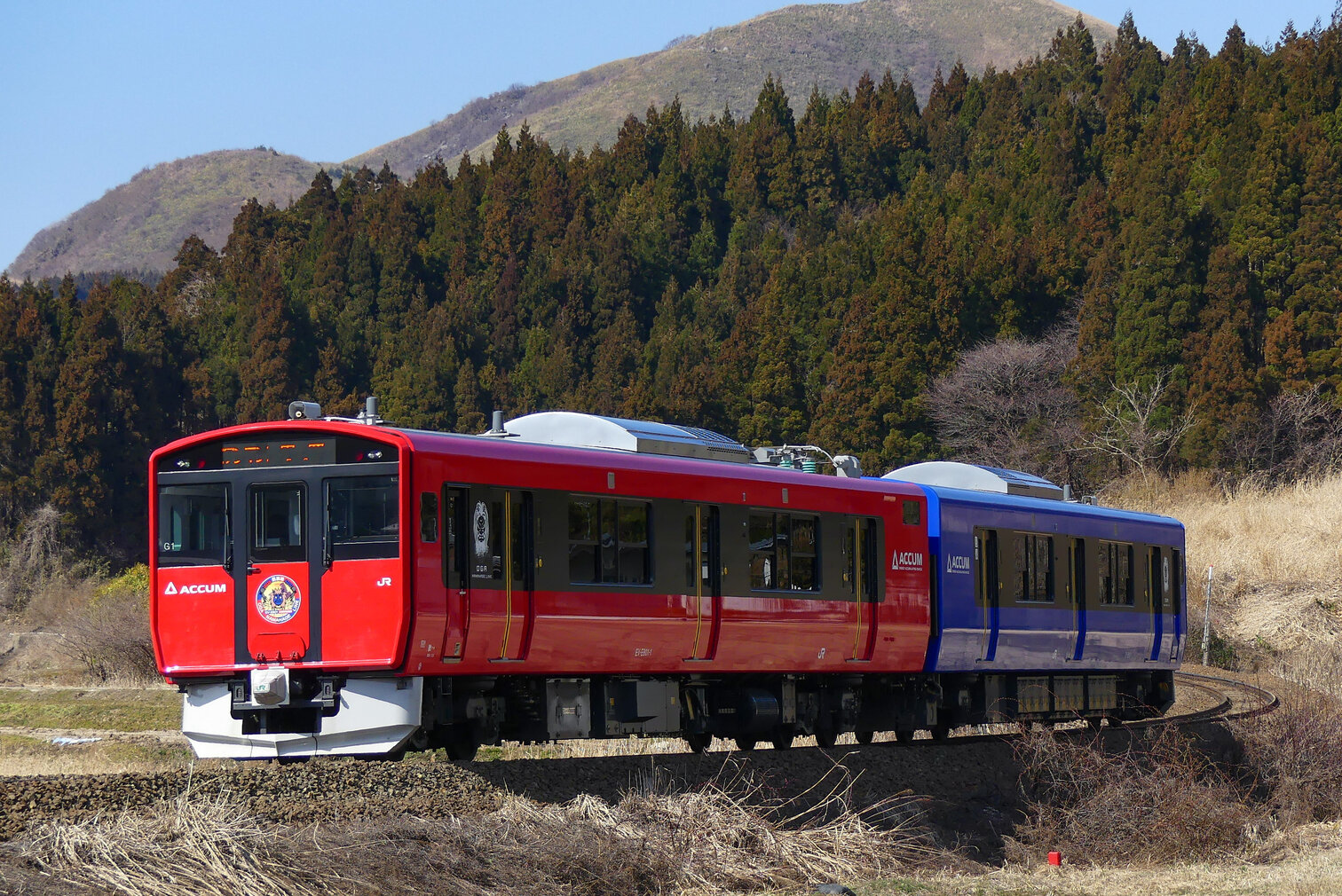
From Akita Station to Oga Station, the Oga Line takes about 53 minutes and costs ¥810. The trains run direct with no change, 14 a day.
The trains on this line are the EV-E801 series, nicknamed "ACCUM," which run on batteries, and namahage (the masked demon figures of Oga's New Year's Eve tradition) are painted on the bodies. They charge on the electrified section and run on battery power on the non-electrified section. As a way into the trip, it is quite a sight.
Arrive in Akita at 10:24 on Komachi 1, catch the 10:38 Oga Line train, and you reach Oga Station at about 11:31. That gives you the whole first afternoon in Oga.
Getting around the peninsula on the Ainori Taxi
The Oga Peninsula is large, and there are almost no local bus routes linking its sights. Instead, there is the Oga Peninsula Ainori Taxi, a shared ride service that you book in advance. It has three routes.
- Namahage Shuttle (year-round): Oga Station, the Shinzan area (Namahage Museum), Oga Onsen, Oga Aquarium GAO and Nyudozaki. It stops at Unshoji too, but only during the special hydrangea viewing period
- Kanpuzan Liner (June 1 to October 31): Oga Station, the Kanpuzan Rotating Observatory and Takinokashira
- Oga Peninsula Gurutto-bin (weekends and public holidays from June 1 to August 31, plus some other days): a service that also visits the Unosaki coast, Godzilla Rock, Happodai and other spots
Reservations are required for every ride. Book online by 21:00 the day before, or by phone by 17:00 the day before. Reservations and inquiries go to the Oga City Tourism Association (0185-24-2100, 9:00–17:00). You can ride alone, and depending on the number of passengers, it runs as a taxi, a jumbo taxi or a bus. Pay in cash or by credit card.
Fares are not flat like a local bus; they depend on the section you ride. From Oga Station: Shinzan area ¥1,100, Unshoji ¥1,300, Oga Onsen ¥1,500, Oga Aquarium GAO ¥1,600, Nyudozaki ¥2,500 (as of June 2026). Elementary school children pay half, and preschool children ride free.
This is where the trick to planning comes in. Between stops other than Oga Station, fares are mostly a flat ¥1,100, except to and from Nyudozaki. Nyudozaki costs ¥2,500 directly from Oga Station but ¥1,600 from Oga Onsen. In other words, hopping from point to point across the peninsula costs less than going out and back from the station.
This plan uses five sections: ¥6,700 per person, ¥13,400 for two. I tried other routes as well: fitting the Namahage Museum into day 1 came to ¥7,400 per person, and returning from Nyudozaki to Oga Station on the last day came to ¥7,600. This itinerary is the cheapest way around.
The thing to note is that hydrangea season is when public transport on Oga is at its best. The shuttle stops at Unshoji only during the special viewing period, and both the Kanpuzan Liner and the Gurutto-bin start running in June. It is one of the few times of year when you can get around the peninsula without a car.
Model itinerary: 3 days, 2 nights
Day 1: Unshoji's hydrangeas, then Oga Onsen
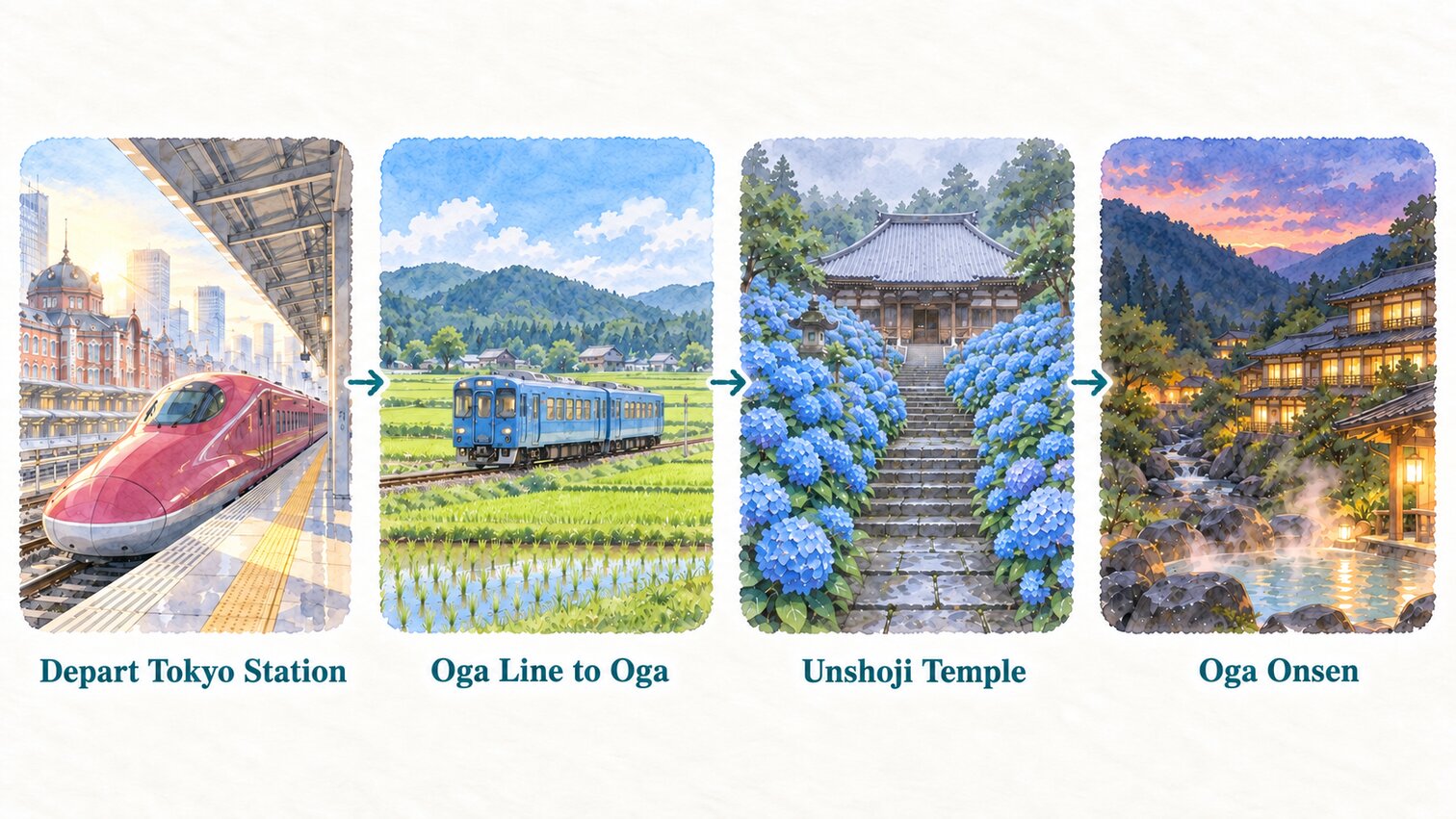
Take Komachi 1 from Tokyo at 6:32. Arrive in Akita at 10:24 and change to the 10:38 Oga Line train, reaching Oga Station at about 11:31. Have lunch there, then take the Namahage Shuttle to Unshoji.
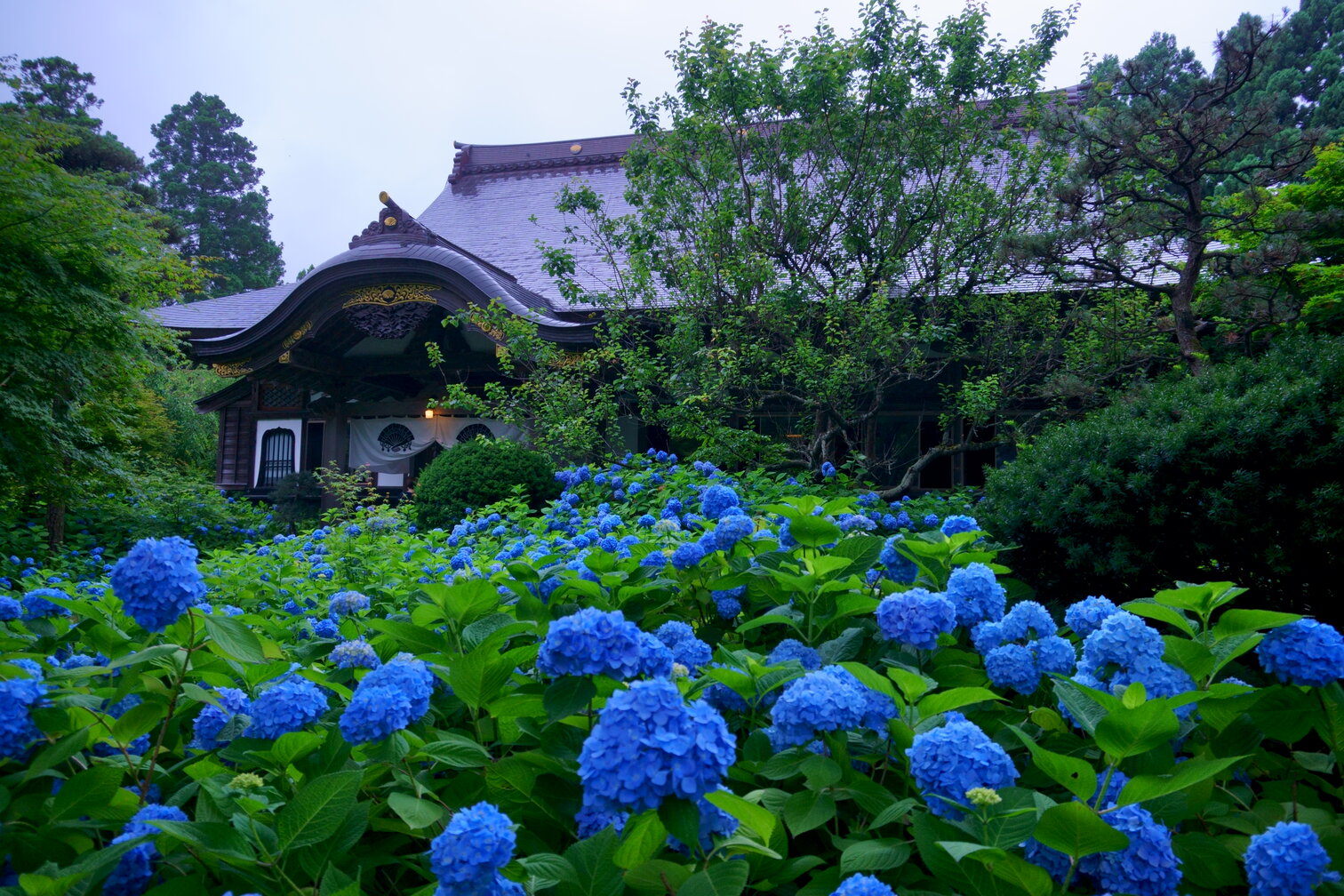
Unshoji is open 9:00–17:00 (last entry 16:30). Admission is ¥700 for adults on weekdays. It is also ¥700 on weekends and public holidays, except on certain busiest weekends, when it goes up to ¥900 (in 2026, these were June 27 and 28 and July 4 and 5). Admission is free for junior high school students and younger.
The temple grounds are not large at all. But the hydrangeas press in so densely within that small space that the real thing should feel more overwhelming than the photos.
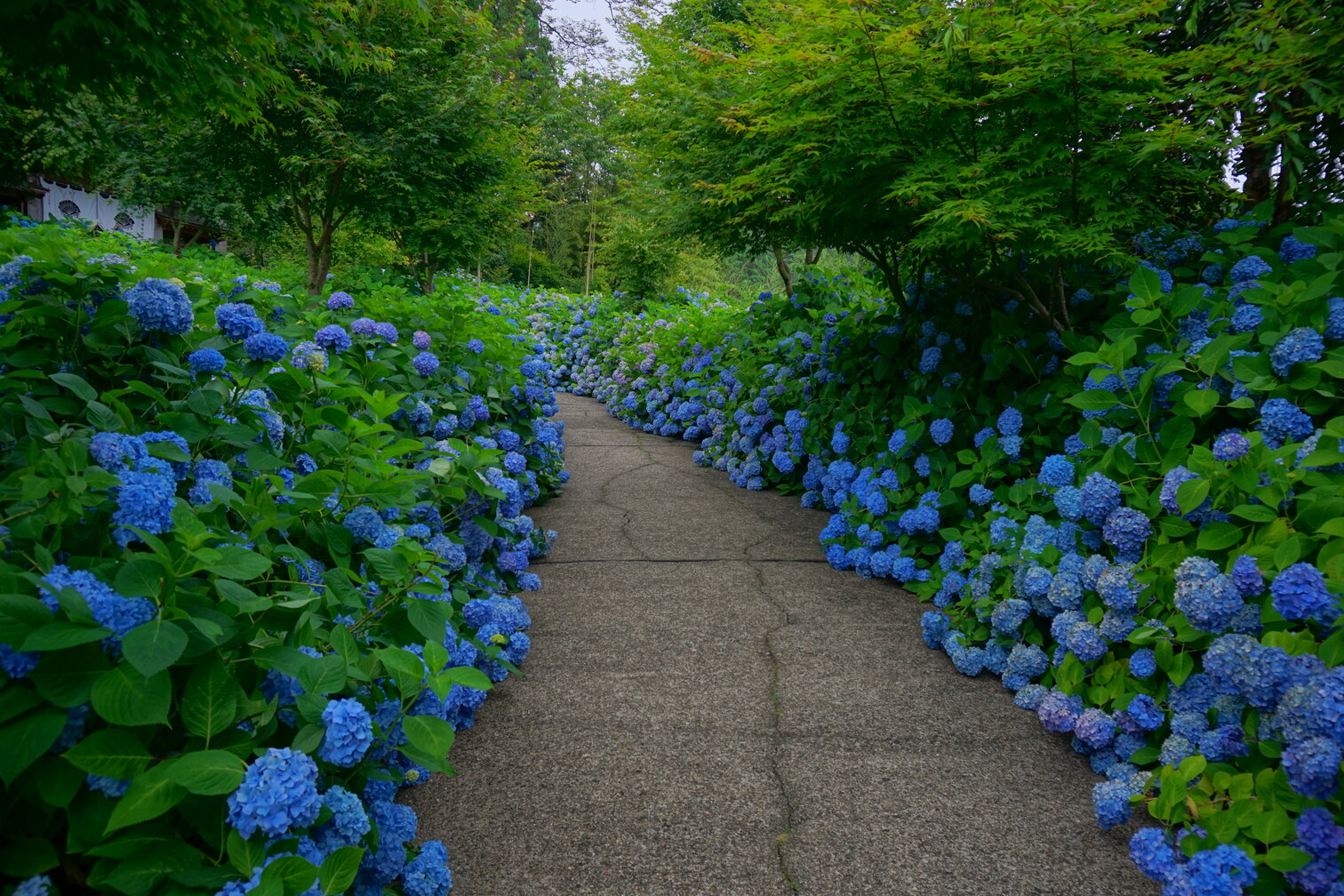
In 2026, the special evening illumination was cancelled. In other years it ran from 18:45 to 21:30, so this is disappointing news for anyone hoping to see the blue flowers lit up. All we can do is wait for an announcement on whether it will return in 2027.
After your visit, take the Namahage Shuttle to Oga Onsen. It is in the same Kitaura district as Unshoji, so it is a short ride.
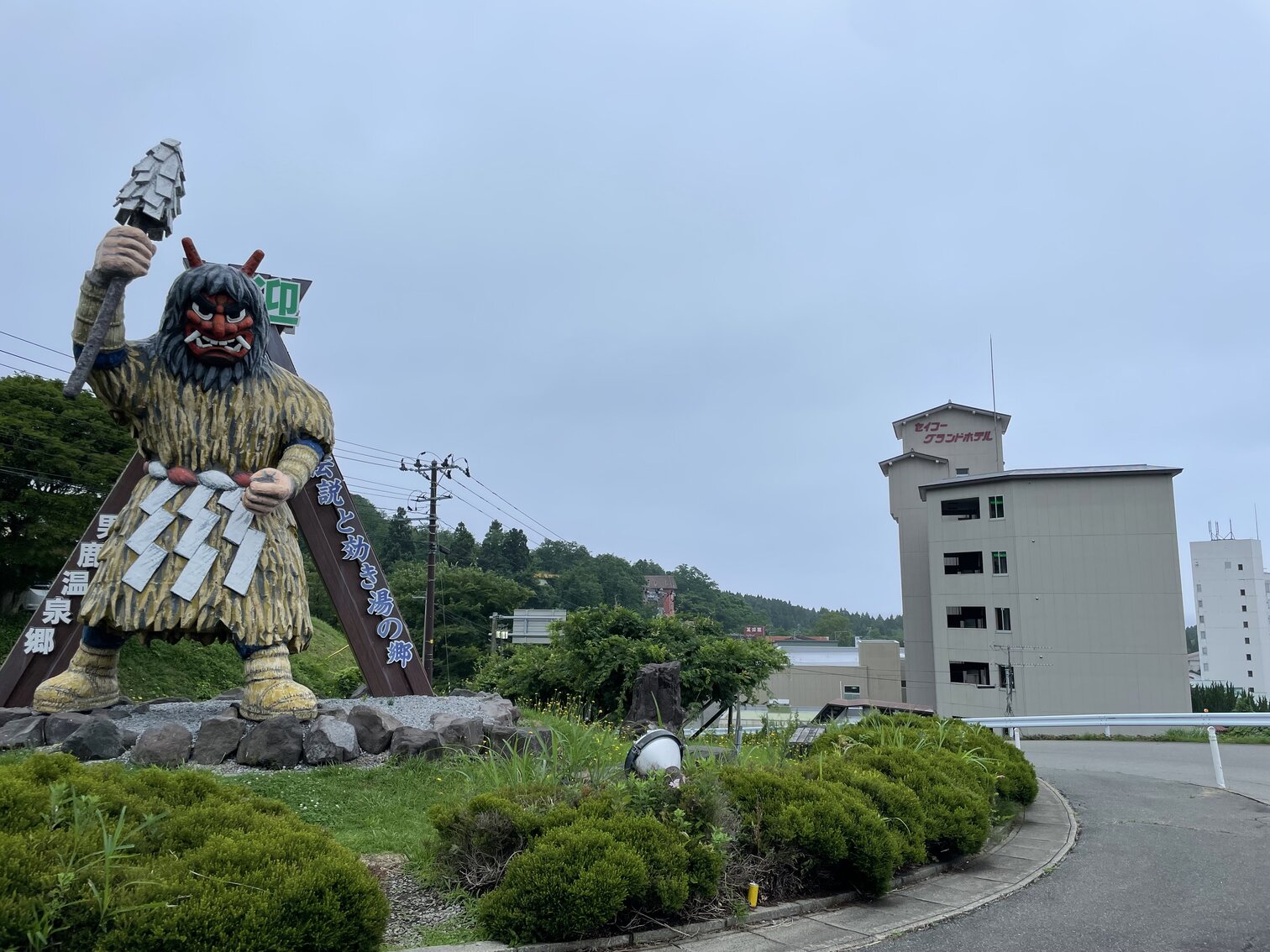
The inn for the night is Motoyu Yuzankaku, a member of the Japan Association of Secluded Hot Spring Inns (Nihon Hito o Mamoru Kai). It is known for ishiyaki cooking: stones heated over charcoal are dropped into an Akita cedar tub, bringing a broth of fish and vegetables to a sudden boil. It is a fisherman's dish. A meal that sends up a cloud of steam in front of you makes a strong first-night dinner.
Before you book, note that the inn has no elevator and a lot of stairs, that preschool children cannot stay, and that the whole building is non-smoking. The latest dinner start time is 19:00.
Day 2: The lighthouse at Nyudozaki, the Namahage Museum, then Akita City
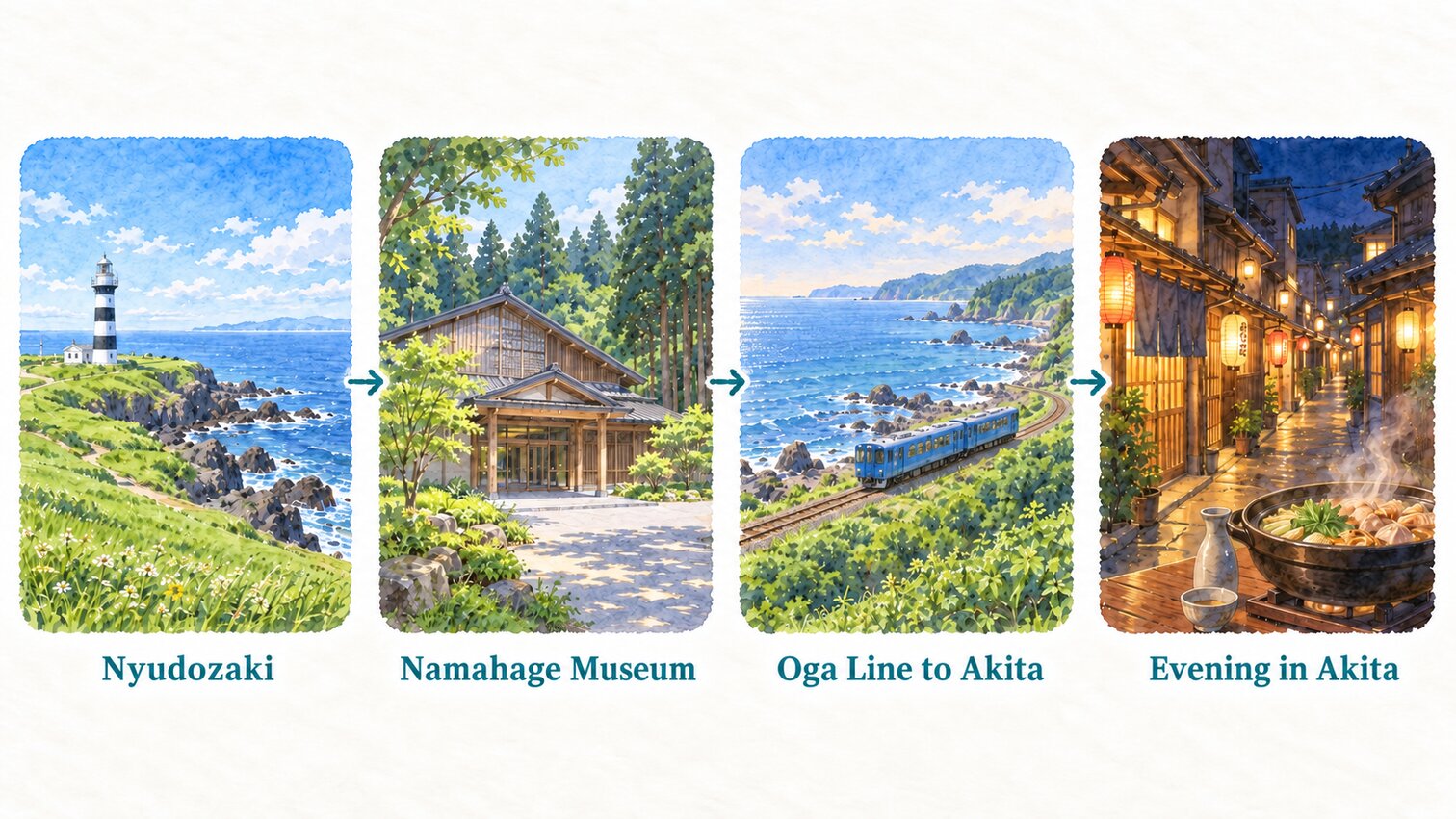
In the morning, take the Namahage Shuttle from the inn to Nyudozaki. This is the northwestern tip of the Oga Peninsula, where green grassland ends abruptly at a cliff and drops into the Sea of Japan.
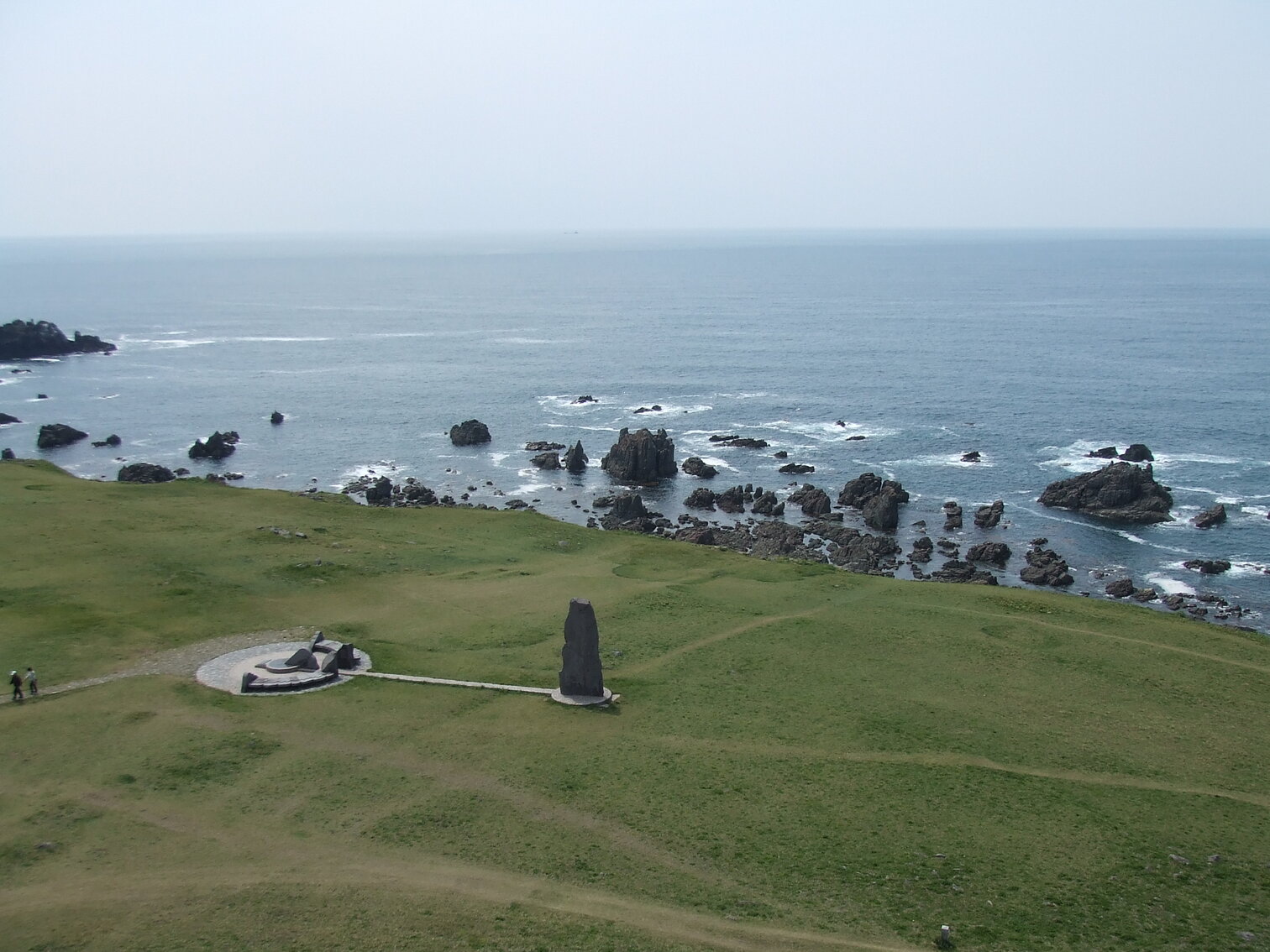
Nyudozaki Lighthouse, with its black and white stripes, is one of only 16 lighthouses in Japan that visitors can climb. The visitor donation is ¥300 for junior high school age and above. The lighthouse is usually open to visitors from early April to early November; in 2026 the season was April 4 to November 8.
Watch the visiting hours here. Mornings are 9:00–12:00 and afternoons 13:00–16:00 (until 16:30 on weekends and public holidays from early April to mid-October only), and it closes between 12:00 and 13:00. Entry ends 20 minutes before closing. The simple way to plan it is to climb in the morning, then have lunch at one of the restaurants at the cape.
After lunch, take the Namahage Shuttle to the Shinzan area for the Namahage Museum. More than 100 namahage masks actually used in villages across the peninsula are on display. At the Oga Shinzan Folklore Museum next door, the New Year's Eve namahage tradition is re-enacted in a tatami room. A combined ticket is ¥1,100 for adults (¥660 for the Namahage Museum alone), and it is open 8:30–17:00, every day of the year.
Take the Namahage Shuttle back to Oga Station, catch the Oga Line train at about 15:38, and arrive at Akita Station at about 16:31.
The hotel in Akita City is Nakadori Onsen Komachi-no-Yu Dormy Inn Akita, an 8-minute walk from Akita Station, with a large natural hot-spring bath and an open-air bath. Its water and atmosphere are different from Oga Onsen's, so over the two nights you get two hot springs of quite different character.
For dinner, go to Kawabata, the restaurant and bar district west of the station. Kiritanpo hot pot (grilled rice sticks simmered in broth), Inaniwa udon, Hinai jidori chicken and hatahata (sandfish): if you want to try Akita's local dishes all at once, this is the night to do it.
Day 3: Walk Akita City and see the giant mural before heading home
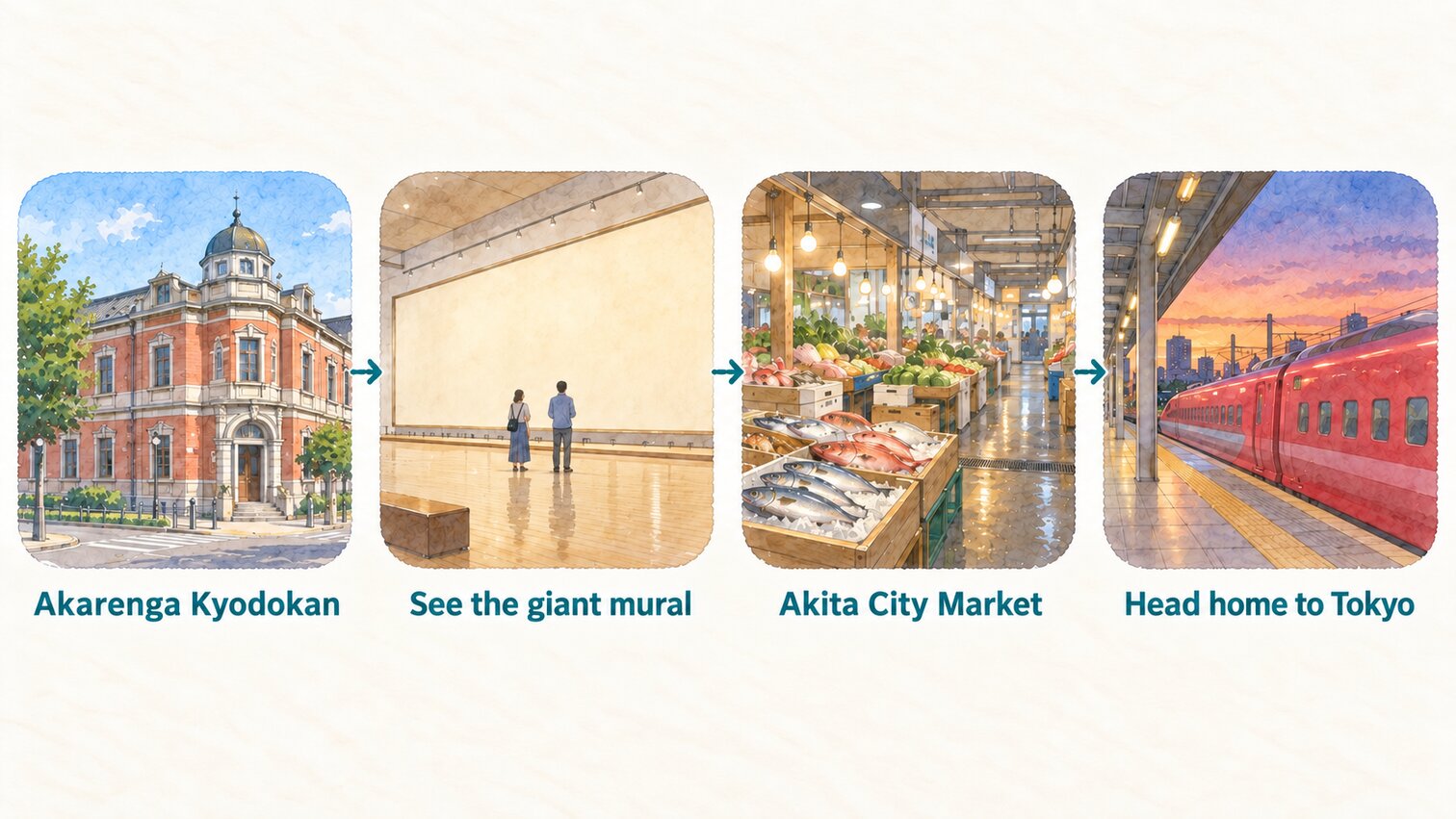
The last day stays entirely around Akita Station. Everything is within walking distance.
Start at the Akita City Akarenga Kyodokan (Red Brick Museum), which opens at 9:30. The Renaissance-style building was built in 1912 as the head office of Akita Bank and is a national Important Cultural Property. Admission is ¥310 for adults, or ¥370 for a combined ticket with the Akita City Folk Performing Arts Heritage Museum (Neburi Nagashi-kan). For just ¥60 more, you can also see a museum displaying real Kanto festival lantern poles. Both are free for high school students and younger.
The Akita Museum of Art opens at 10:00. This is the destination of the last day.
Fujita Tsuguharu's Events of Akita is 3.65 meters high and 20.5 meters wide. It is said to have been painted in 1937 in just 15 days, in a rice storehouse belonging to the Akita businessman Hirano Masakichi. The Kanto festival, Bonten, namahage, the market: the events of Akita's four seasons are packed into a single painting. It is on permanent display in the mural gallery on the second floor. The museum is open 10:00–18:00 (last entry 17:30). Admission is ¥310 for adults, ¥210 for university students and free for high school students and younger. It is about a 10-minute walk from Akita Station.
A painting 20 meters wide for ¥310. I think this is the best-value spend of the whole plan.
For lunch, go to Akita City Market (Akita Shimin Ichiba), a 5-minute walk from Akita Station, with fresh fish, prepared foods and souvenirs. However, it is closed on Sundays, so this does not work if your last day falls on a Sunday. It opens from around 5 a.m., so by midday you can walk through the whole thing.
If you have time left over, take a walk in Senshu Park (the Kubota Castle ruins). Late June, though, falls between seasons with no flowers: the azaleas (early May) are over, and it is too early for the lotuses (July). The Kubota Castle Osumi Yagura turret is ¥150, and the Satake Historical Museum's permanent exhibition is ¥500.
Take Komachi 34 from Akita at 16:12, arriving in Tokyo at 20:04.
Estimated cost (total for two, with per-person figures)
With the Shinkansen and a night at Yuzankaku
- Shinkansen (Komachi, Tokyo ⇔ Akita, reserved-seat round trip): ¥73,840 / ¥36,920 per person
- Night 1 (Motoyu Yuzankaku, ishiyaki dinner and breakfast included): ¥50,000 / ¥25,000 per person
- Night 2 (Dormy Inn Akita, breakfast included): ¥23,400 / ¥11,700 per person
- Local transport (Oga Line round trip and Namahage Shuttle): ¥16,640 / ¥8,320 per person
- Sightseeing (Unshoji, Nyudozaki Lighthouse, Namahage Museum combined ticket, Akita Museum of Art, Akarenga combined ticket): ¥5,560 / ¥2,780 per person
- Meals and incidentals: ¥18,000 / ¥9,000 per person
Total: about ¥187,000 for two (about ¥94,000 per person) (about ¥194,000 for two if the inns charge their peak-season maximum)
Cheaper lodging on both nights
Switch night 1 to Oga Kanko Hotel (dinner and breakfast with a 90-minute buffet, around ¥36,000 for two) and night 2 to Richmond Hotel Akita Ekimae (breakfast included, around ¥16,000 for two), and the total comes to about ¥166,000 for two (about ¥83,000 per person). You give up the ishiyaki dinner and save a little over ¥20,000.
Go between mid-June and mid-July
The star of this plan is Unshoji's hydrangeas, so they decide the timing. In 2026, the viewing period ran from June 13 to July 20. The dates shift with how the flowers are blooming, so for 2027 you will have to wait for the announcement in early spring.
The flowers are not the only reason to choose this season. As mentioned above, the Kanpuzan Liner and the Gurutto-bin also start running around this time. Hydrangea season happens to be exactly when the Oga Peninsula is easiest to get around by public transport.
Winter, on the other hand, shows Oga's other face: the namahage tradition on New Year's Eve, and the Namahage Sedo Festival in February. In winter, though, Nyudozaki Lighthouse is closed to visitors, and the Namahage Shuttle does not stop at Nyudozaki (November 1 to March 31). On the same peninsula, the places you can reach change with the season.
What I honestly still do not know
- Changes to Namahage Shuttle fares. The fares in this article are as of June 2026. The fare page on the Namahage Shuttle's official website has been showing an error for some time, so the surest way is to confirm by phone (0185-24-2100) when you book.
- The 2027 hydrangea viewing period. This article assumes a trip in June 2027, but Unshoji sets its viewing period each year according to how the flowers are blooming. In 2026 it was June 13 to July 20.
- Whether the evening illumination will return. It was cancelled in 2026. If seeing the blue hydrangeas lit up is your goal, check for an announcement before you fix your dates.
- Actual accommodation prices. Bookings for June 2027 are not open yet (most places open about six months ahead). The estimate is built from JTB's year-round price ranges and actual prices in other seasons. Hydrangea season is Oga's busy season, so I expect prices to be toward the top of those ranges. Once bookings open around December 2026, check the actual prices.
- No time for Kanpuzan. The Oga Peninsula has a grassy mountain called Kanpuzan, and its rotating observatory looks out over the whole peninsula. But the Kanpuzan Liner starts from Oga Station, so you cannot go there directly from Oga Onsen. Adding it to this itinerary would mean dropping either Nyudozaki or the Namahage Museum. If you can stay three nights, this is the best place to add.
Conclusion
¥74,000 for the round trip from Tokyo to Akita for two. If you are paying that much to get there, coming home after one night would be a waste. That is the thinking behind this 3-day, 2-night plan.
Temple grounds turned entirely blue, and a painting 20 meters wide. Both show how overwhelming one thing can be, whether through sheer numbers or size, and in between come the ishiyaki dinner at Oga Onsen and Akita's local dishes. The total is about ¥187,000 for two, or about ¥94,000 per person. It is the most expensive of Doko10's plan articles, but I think what you get matches how far you have to go.
Photos from Wikimedia Commons: Oga-Line-EV-E801-G1 (MaedaAkihiko / CC BY-SA 4.0), Unsho-ji, Oga 20210706d (掬茶 / CC BY-SA 4.0), Unsho-ji, Oga 20210706a (掬茶 / CC BY-SA 4.0), Oga Onsenn-kyo (Totti / CC BY-SA 4.0), and NyudozakiViewFromLighthouse (Ippukucho / CC BY 3.0). All resized only. Illustrations are for reference.


Estimated cost (total for two, two people sharing one room / per person)
- Shinkansen (Komachi, Tokyo ⇔ Akita, reserved-seat round trip): ¥73,840 / ¥36,920 per person
- Night 1 (Motoyu Yuzankaku, dinner and breakfast): ¥50,000 / ¥25,000 per person
- Night 2 (Dormy Inn Akita, breakfast): ¥23,400 / ¥11,700 per person
- Local transport (Oga Line and Namahage Shuttle): ¥16,640 / ¥8,320 per person
- Sightseeing: ¥5,560 / ¥2,780 per person
- Meals and incidentals: ¥18,000 / ¥9,000 per person
- Total: about ¥187,000 for two (about ¥94,000 per person)