This is a desk-researched itinerary. I have not visited Iwami Ginzan or Yunotsu. It is a trip I would like to take, planned as seriously as if I were actually booking it. Prices and operating information were checked in September 2026, but please confirm the latest details on official websites before you travel.
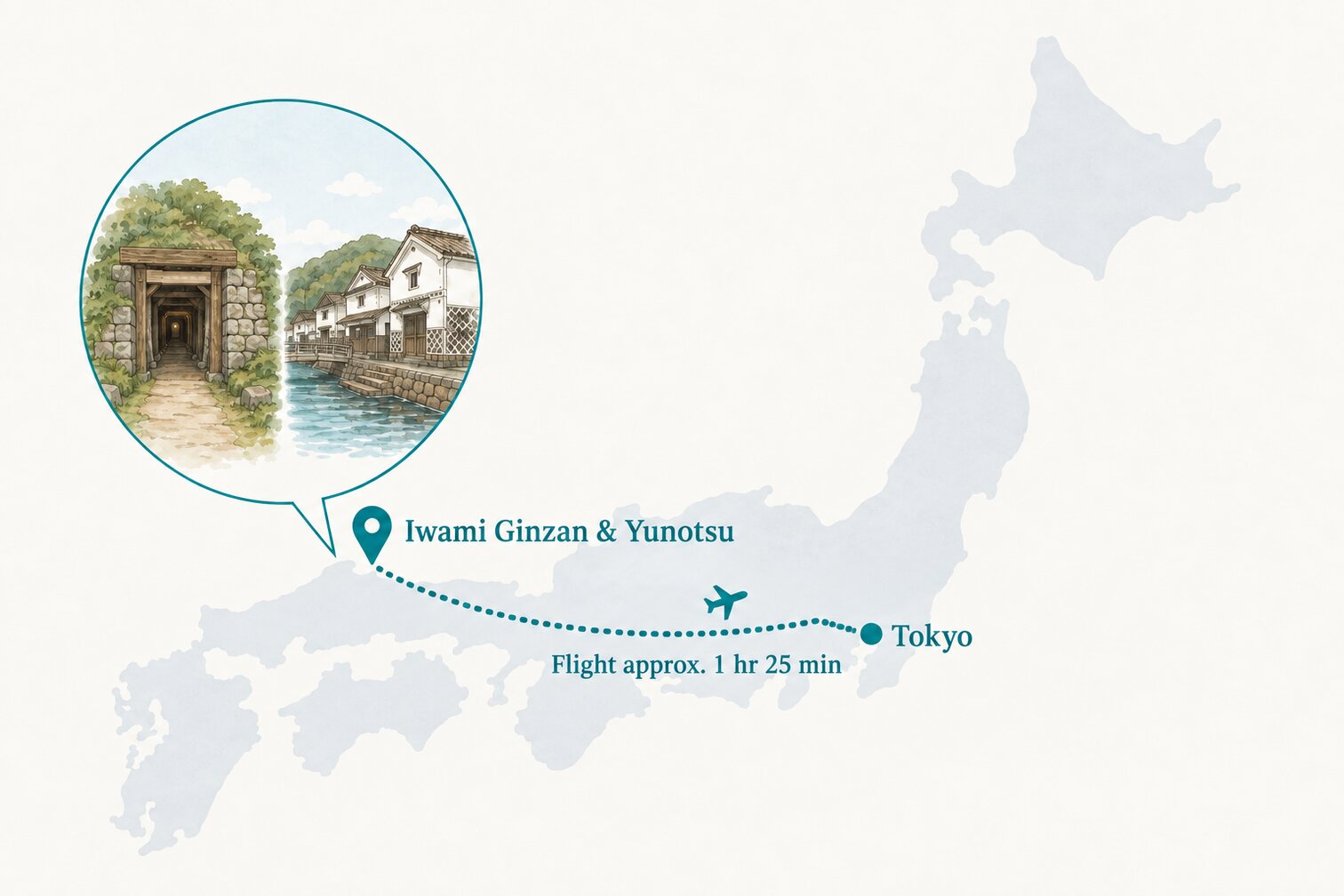
The plan at a glance
- Length: 2 days, 1 night from Tokyo, flying in and out.
- Destination: Iwami Ginzan and Yunotsu Onsen in Oda, Shimane Prefecture.
- Day 1: Haneda → Izumo Airport → train and bus to Iwami Ginzan → rental bike to the old mine tunnel → an inn in Yunotsu.
- Day 2: A walk through the hot-spring town and a public bath → warigo soba in Izumo → Izumo Airport → Haneda.
- Recommended: stay on a Saturday night. Yunotsu holds an Iwami Kagura performance every Saturday evening (more on that below).
- Estimated cost: about ¥62,000 per person, if you get early-booking airfares.
- Bottom line: how you buy the flights decides the answer. Book early and there is room to spare; buy at the last minute and it goes over ¥100,000.
Why Iwami Ginzan and Yunotsu?
The two destinations are Iwami Ginzan, a former silver mine in Shimane Prefecture, and Yunotsu Onsen.
Iwami Ginzan became a UNESCO World Heritage site in 2007. During the Edo period, it is said to have produced a considerable share of the world's silver, and its old mine tunnels survive as they were. Yunotsu was the port that shipped that silver out. It still keeps its Edo-period street layout and the atmosphere of a traditional tōji bathing town, a place for taking the waters. Unusually for a hot-spring town, the whole townscape is reportedly designated an Important Preservation District for Groups of Traditional Buildings.
It is a World Heritage site, yet I have never met anyone around me who has been there. The reason is probably distance. From Tokyo, the western side of Shimane Prefecture is among the hardest places in Japan to reach. That is exactly why I thought it was worth working out what it really costs.
Getting there
By Shinkansen via Okayama it takes nearly seven hours, so flying is the only real option.
- Haneda → Izumo Enmusubi Airport (Izumo Airport): about 1 hour 25 minutes on JAL. Five flights a day; the first leaves at 7:10 and the last at 18:15.
- Izumo Airport → Izumoshi Station: about 30 minutes by airport bus, ¥850.
- Izumoshi Station → Odashi Station: about 40 minutes on the JR San'in Line, ¥590.
- Odashi Station → Iwami Ginzan (Omori Daikansho-ato, the site of the former magistrate's office): about 26 minutes by Iwami Kotsu bus, ¥640.
This is the key point of the whole plan. JAL is the only airline flying between Haneda and Izumo, so there is no low-cost carrier to fall back on. Book early and one-way fares start in the low ¥10,000s; buy at the last minute at the normal fare and a one-way ticket costs more than ¥40,000. That is more than three times the price for the same seat. The budget for this trip depends less on where you stay than on when you buy your flights.
Model itinerary: 2 days, 1 night
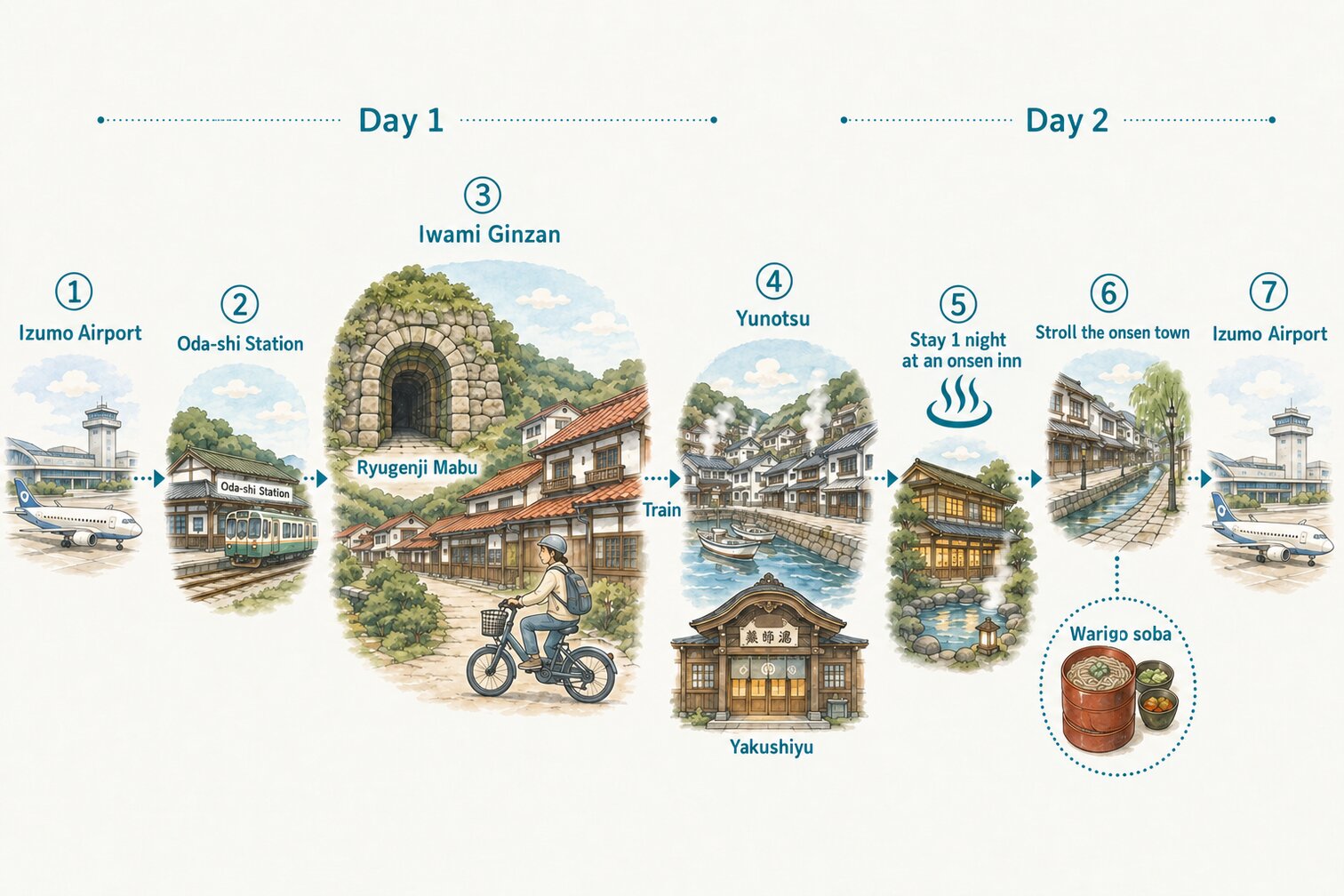
Day 1: The first flight out, arriving around noon, the mine tunnel in the afternoon
Take the first flight from Haneda at 7:10 and you land at Izumo Airport a little after 8:30. At Izumoshi Station, though, you have to wait for a train connection. The San'in Line train you can catch there is the 10:33 local, arriving at Odashi Station at 11:15. Change to the 11:32 bus and you reach Omori Daikansho-ato at 11:58. You arrive at the entrance to Iwami Ginzan around noon, so the mine tunnel is an afternoon visit.
The highlights of Iwami Ginzan are Ryugenji Mabu, the mine tunnel open to the public, and the Omori townscape that spreads out on the way to it. The tunnel is 2.3 km one way from the center of town, a gentle 45-minute uphill walk, so I would rent an electric bike near Omori Daikansho-ato (¥700 for two hours). The standard route seems to be riding up to the tunnel first and walking through the townscape on the way back.
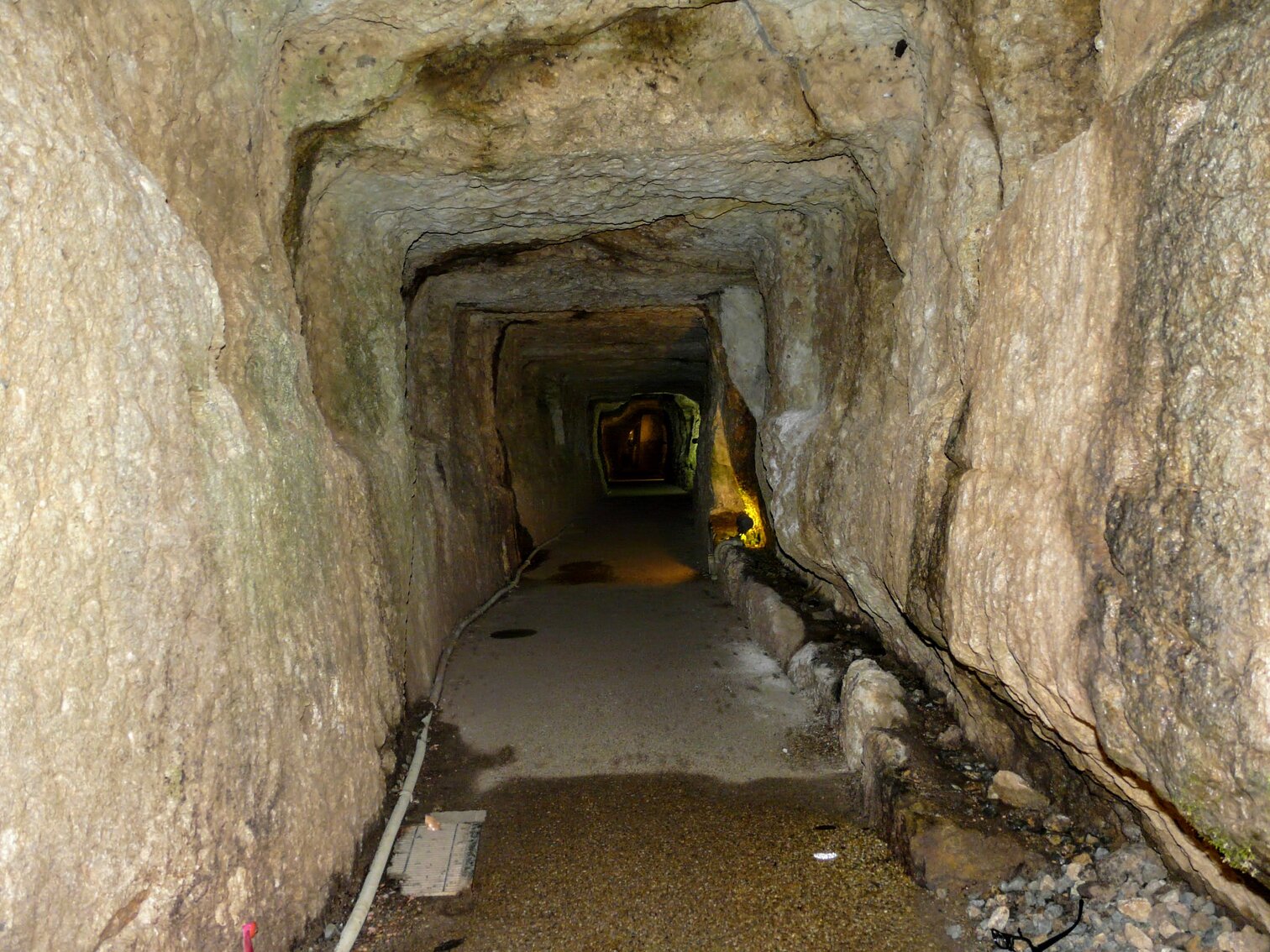
The local guide association also runs a daily "One Coin Tour" (¥500) departing at 10:30 and 13:00. If you arrive at noon, it makes sense to have lunch first and join the 13:00 tour. I am convinced the silver mine's story is far more interesting with someone explaining it. If you are leaving Omori on a bus in the 15:00 hour, though, riding out to the tunnel and back after the tour is very tight. Be prepared to choose between the tour and the bike.
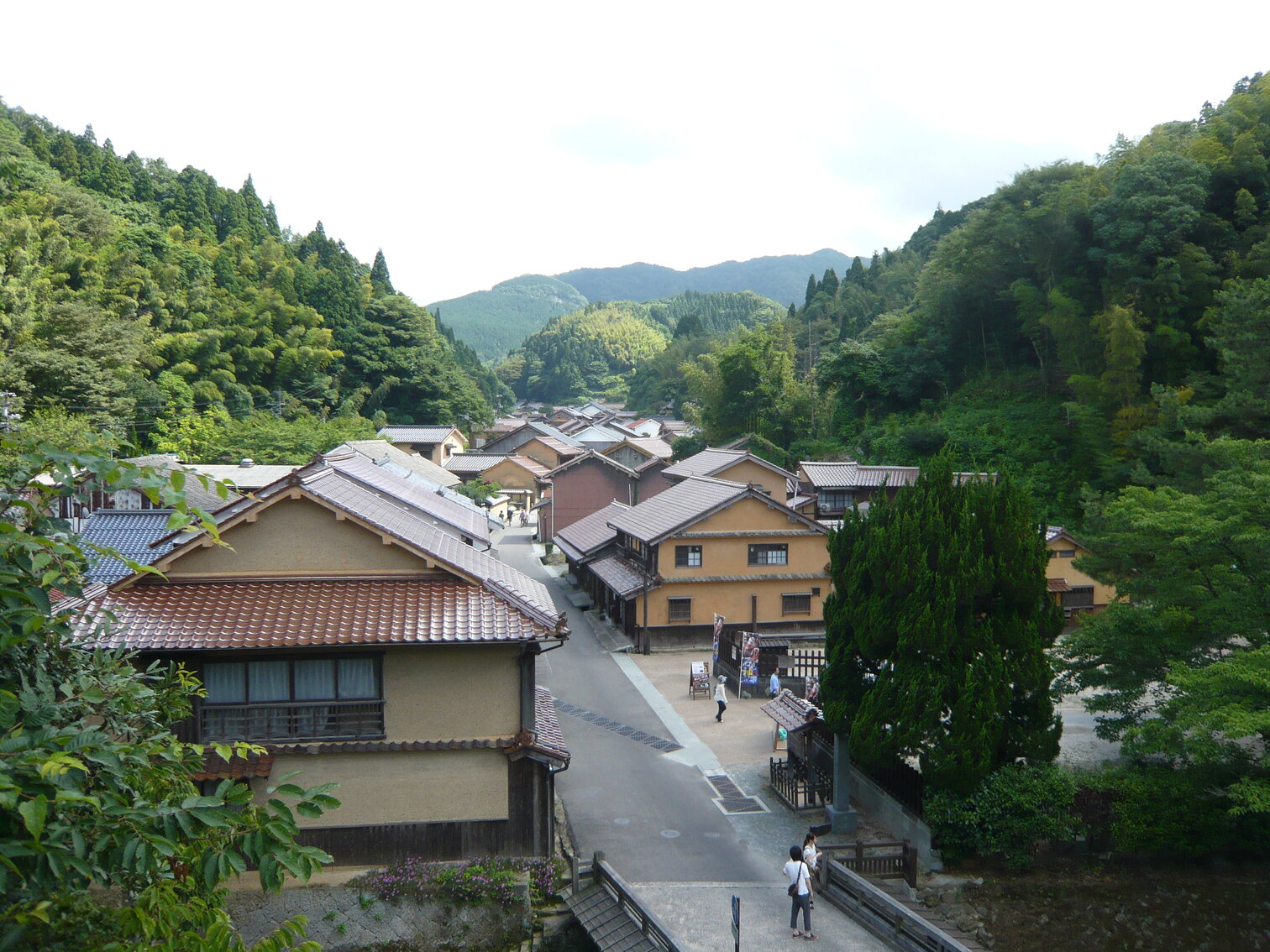
For lunch, there are places to eat within the Omori townscape: Gungendo's Iwami Ginzan main store, set in a renovated old house (lunch last order 15:00), or Oshokujidokoro Omori, right by the Daikansho-ato bus stop. Both close on Wednesdays, so it is safest to avoid a Wednesday.
Take the 15:27 bus from Omori Daikansho-ato to Nima-ekimae (¥450, arriving 15:45). One thing to watch here: the next train toward Yunotsu leaves at 16:43. That leaves about an hour to wait, but the Nima Sand Museum, home to the world's largest hourglass, is about a 10-minute walk from Nima Station and fills the gap nicely. The 16:43 train reaches Yunotsu Station at 17:07 (¥200). It is about a 15-minute walk from the station to the hot-spring town, so you should reach your inn around 17:30.
Yunotsu is a small hot-spring town, and its inns are small too. On Rakuten Travel I found three: Ryokan Masuya, founded in 1910 (Meiji 43), a three-story wooden building with just eight rooms; Nogawaya Ryokan, a long-established inn dating from the Taisho era, known for its locally caught fish; and Kiunso. All three put the local catch at the center, so dinner at the inn is the obvious choice. With so few rooms, it seems wise to book early. Kiunso's official website offers a free pickup from Yunotsu Station, so arriving after 17:00 is not a problem.
Once you have checked in, visit the Yakushiyu public bath before dinner (¥600 for adults, 9:00–21:00). Its free-flowing spring water received the top rating in an assessment by Japan's hot spring association (日本温泉協会), and the tubs are reportedly thickly coated with mineral deposits from the water.
Day 2: A morning walk through the bathing town, then warigo soba
In the morning, walk through the hot-spring town to the port. The streets still follow their Edo-period layout, and are said to be lined with white-walled storehouses and houses with latticework fronts.
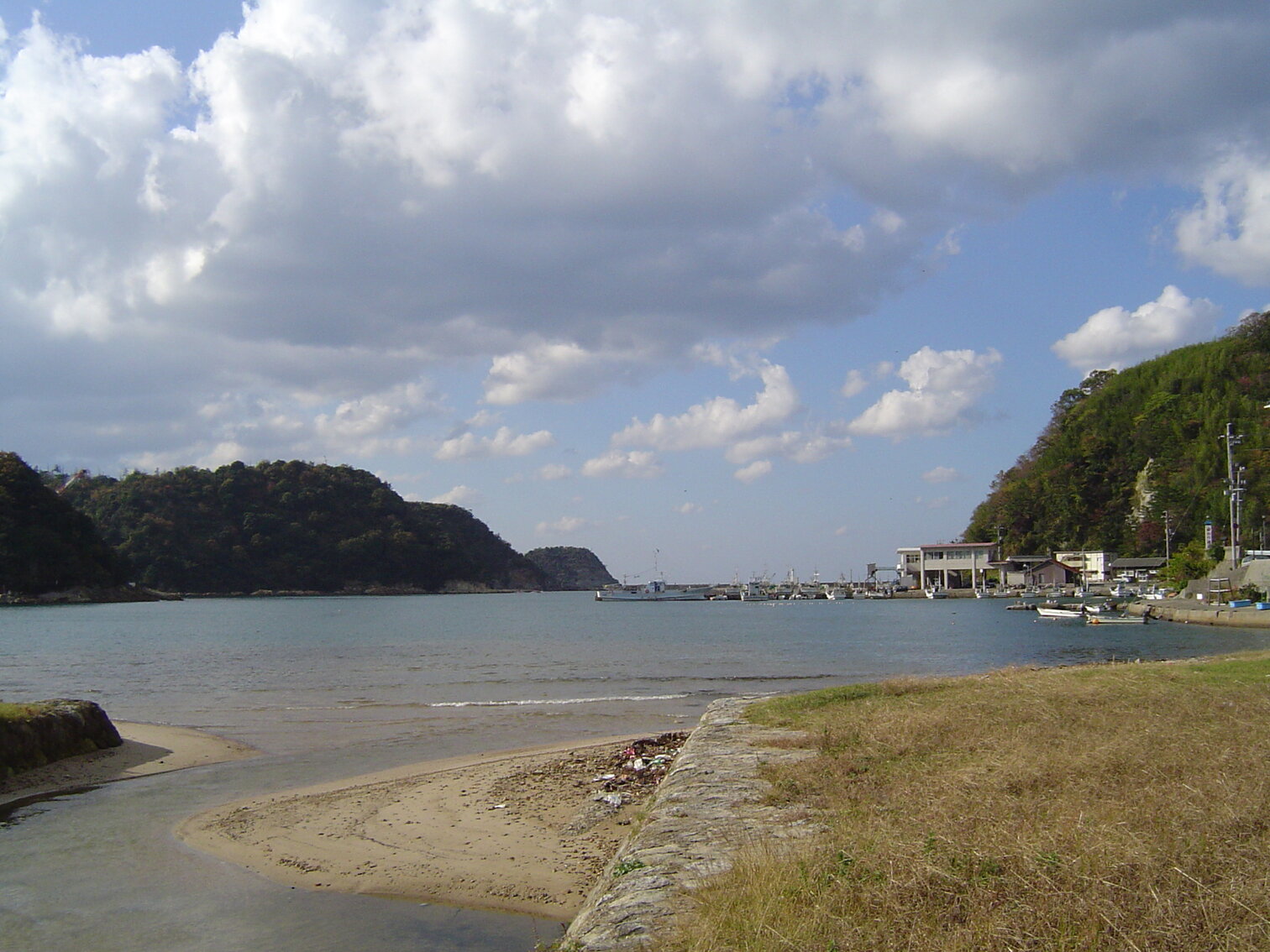
I only learned this while researching: Yunotsu's other public bath, Motoyu, changed how it operates from January 2026. On Mondays and Thursdays, it is open to the general public only from 6:00 to 8:00 in the morning, and after that it is for reserved members only. On other days it is reportedly open all day, so this is worth keeping in mind when you choose which day to go.
Leave Yunotsu Station before noon for Izumoshi Station. For lunch, have warigo soba, a style of Izumo soba, then take the airport bus. An afternoon flight gets you back to Haneda by evening.
Estimated cost per person
Assuming two people share one room:
- Flights: Haneda ⇔ Izumo round trip, about ¥28,000 (assuming early-booking fares of ¥12,000–¥16,000 each way).
- Airport bus: round trip, ¥1,700.
- Local trains and buses: ¥2,870 (Izumoshi → Odashi ¥590, Odashi Station → Omori Daikansho-ato ¥640, Omori Daikansho-ato → Nima-ekimae ¥450, Nima → Yunotsu ¥200, Yunotsu → Izumoshi ¥990).
- Lodging: dinner and breakfast included, about ¥22,000 (in the ¥20,000s to ¥30,000s depending on the inn and plan).
- Bike rental, bath and admission: ¥1,800 (bike ¥700 + Yakushiyu ¥600 + Ryugenji Mabu ¥500).
- Two lunches and incidentals: ¥6,000.
Total: about ¥62,000
That assumes you get early-booking airfares, though. Buy at the last minute at the normal fare and the round trip alone goes over ¥90,000. If it is just over that, the total comes to the ¥120,000s, clearly above ¥100,000. The Tomonoura and Ueda trips were ones you could take whenever you decided to go. Here, you can go if you decide two months ahead.
Put the other way, at ¥62,000 with early fares you still have ¥38,000 left under ¥100,000. Even if you added a visit to Izumo Taisha shrine on day 2 and another night, making it a 3-day, 2-night trip, it looks like it would still fit within ¥100,000.
Prices are based on information checked in September 2026. Airfares vary greatly by season and by when you buy, and accommodation prices vary by date and plan.
Go on a Saturday
This was the discovery that made me think, "This is it." Tatsunogozen Shrine, in Yunotsu's hot-spring town, holds a regular Iwami Kagura performance every Saturday night (all seats by reservation). It was once the shrine of the guardian deity of Yunotsu port, from which Iwami Ginzan's silver was shipped out, so this is night kagura performed in an actual shrine. The evening after dinner at the inn was free, so I would build the dates around a Saturday-night stay to fill it.
What I still do not know
This is a desk-researched itinerary, so I want to be clear about what I could not fully confirm.
- Whether Ryokan Masuya offers a pickup from the station. Rakuten Travel lists it as having "bus tickets available," which may be a separate arrangement from a pickup service.
- Whether both the One Coin Tour and the bike ride to the tunnel can fit in before the 15:27 bus after a noon arrival. I will not know until I walk it.
- Airport bus departure times and JR connections may change by date, so check them before you set off.
- There are a lot of day-of-week constraints. On Wednesdays the main places to eat in Omori are closed, and on Mondays and Thursdays Motoyu is open to the public only in the early morning. Tuesday, Friday, Saturday or Sunday look like the safest days to go.
Conclusion
A World Heritage site among the farthest from Tokyo, and a bathing town that keeps its Edo-period street layout. With early-booking flights, it comes to about ¥62,000 per person; without them, over ¥100,000.
What I found in the research was not that "far away means expensive," but that "far away means planning ahead changes the price." As long as you decide two months in advance, the numbers say ¥100,000 buys you a World Heritage mine tunnel, a tub coated with mineral deposits, and a dinner of local fish.
Photos from Wikimedia Commons: Iwami Silver Mine Ryugenji Tunnel 001 (Naokijp / CC BY-SA 4.0), Omori town south (Opqr / CC BY-SA 3.0), and Yunotsu -温泉津- (2046263111) (contri / CC BY-SA 2.0). Resized only. Illustrations are for reference.


Estimated cost per person, based on two people sharing one room
- Flights Haneda ⇔ Izumo round trip: about ¥28,000 (with early-booking fares)
- Airport bus round trip: ¥1,700
- Local trains and buses: ¥2,870
- Lodging, dinner and breakfast included: about ¥22,000
- Bike rental, bath and admission: ¥1,800
- Two lunches and incidentals: ¥6,000
- Total: about ¥62,000 (in the ¥120,000s if last-minute round-trip airfare is just over ¥90,000)