This is a researched model itinerary for most of the year, not a first-hand trip report. We tested it against November 17–19, 2026 (Tuesday to Thursday), using official sources checked in October 2026. JR East's online timetables show each JR train below running on those dates. The Moka Railway and Kanto Bus times come from the operators' current timetables. The Kanto Bus legs below were checked for the November 17–18, 2026 example dates. Recheck the operator's date-specific journey search before your own trip. Timetables change, rooms and classes fill up, and anything we could not confirm is marked. Recheck times, opening days, availability and prices for your own dates before you book.
If you like using handmade cups and bowls as much as looking at them, Mashiko and Kasama are worth more than a rushed day trip from Tokyo.
The two towns sit on either side of the Tochigi–Ibaraki prefectural border, about two hours apart by local train with one change. Each has its own pottery tradition, its own museum and plenty of shops and studios. Staying one night in each lets you compare them properly instead of seeing both through a train window.
This plan spends the first night in Mashiko, adds a hands-on wheel class the next morning, crosses to Kasama by rail and finishes with the main ceramics museum before returning to Tokyo. No rental car is needed. What you do need is a little respect for regional timetables, because trains and buses here run far less often than in Tokyo.
The trip at a glance
- Day 1: Tokyo to Mashiko by JR and bus. Browse the pottery shops and, if time allows, the Mashiko Museum of Ceramic Art.
- Day 2: Morning wheel class in Mashiko, then the Moka Railway and JR Mito Line to Kasama.
- Day 3: Ibaraki Ceramic Art Museum and Kasama Craft Hills, then back to Tokyo.
The plan assumes two adults sharing one room, starting and ending in Tokyo. International flights and airport transfers are not included.
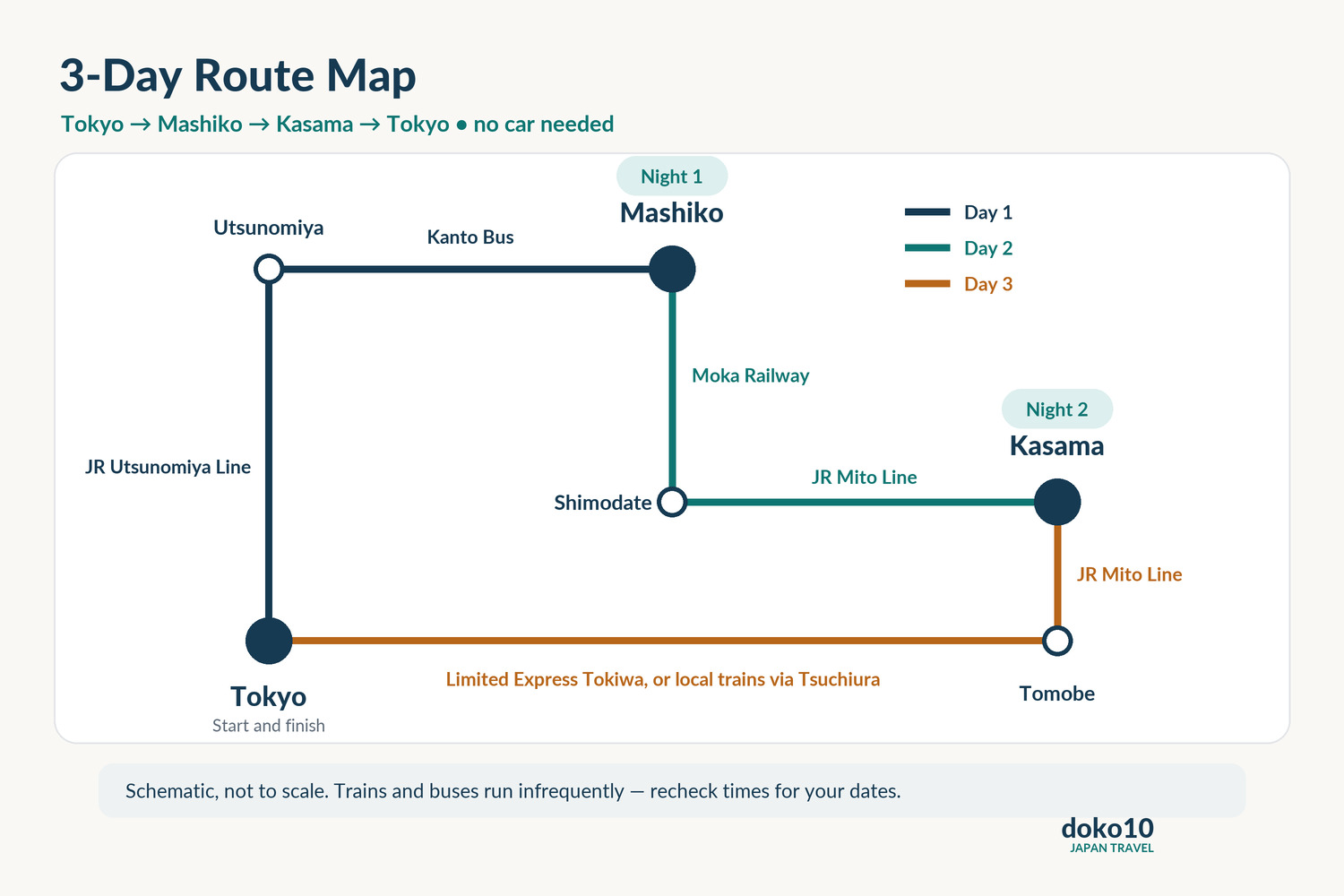
Day 1 — Tokyo to Mashiko
The simplest way in is the JR Utsunomiya Line to Utsunomiya, then a Kanto Bus service that stops near the pottery district. On weekdays, the timetables give this connection:
Swipe sideways or use arrow keys to view all columns and notes.
| Leg | Example times | Notes |
|---|---|---|
| Tokyo → Utsunomiya, JR Utsunomiya Line (Ueno–Tokyo Line) | 8:40–10:34 | Local train 1546E, weekdays only. Shown running on Tuesday, November 17, 2026. |
| Utsunomiya Station West Exit → Mashiko Sankokan Iriguchi, Kanto Bus | 11:03–12:01 | Adult fare ¥1,350. The bus continues to Mashiko Station. The November 17 times and fare here, and the Day 2 bus on November 18, were checked in Kanto Bus's date-specific route search on October 19, 2026. Recheck before travel, as timetables and services may change. |
That leaves almost half an hour at Utsunomiya to get from the JR gates to the West Exit bus stop. If you miss the 11:03, the next bus on the same timetable leaves at 12:33 and reaches Mashiko Sankokan Iriguchi at 1:31 p.m. These are weekday times. Weekends and holidays run to a different timetable. Kanto Bus's journey search only covers dates up to 31 days ahead, so recheck the bus for your own date once it comes within range.
On these buses you board at the rear door and pay when you get off at the front, taking a numbered ticket as you board if you pay cash. Cash or a supported transit IC card (such as Suica) is accepted.
The guesthouse used in this plan is about 500 meters from the Mashiko Sankokan Iriguchi stop. The studio that runs it describes the walk from its nearest bus stop as about five minutes.
Spend the afternoon on foot in the pottery district. Jonaizaka, the main street of central Mashiko, is about ten minutes' walk from the guesthouse and is lined with galleries and shops. The pleasure is in comparing shapes, glazes and textures rather than hunting for one famous shop. Plenty of what is on sale is everyday tableware, made to be picked up and used.
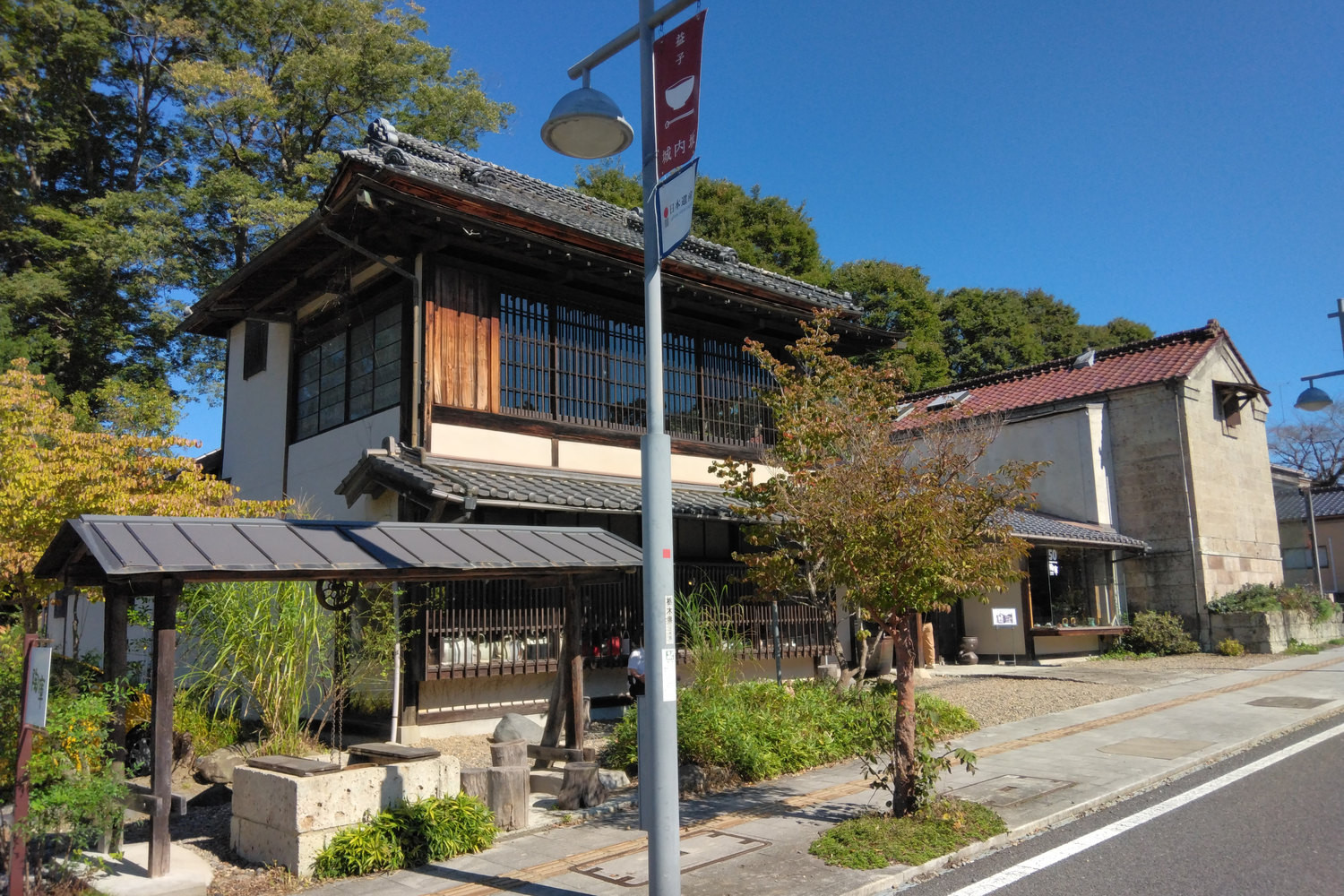
If you have time, visit the Mashiko Museum of Ceramic Art. It gives useful context for what you will see in the shops. From February to November it opens 9:30 a.m.–5:00 p.m., with last entry at 4:30 p.m. (December–January closes half an hour earlier). Standard adult admission is ¥600, although some exhibitions carry special pricing. It closes on Mondays (the next day when Monday is a public holiday) and for exhibition changeovers, so check the calendar for your dates.
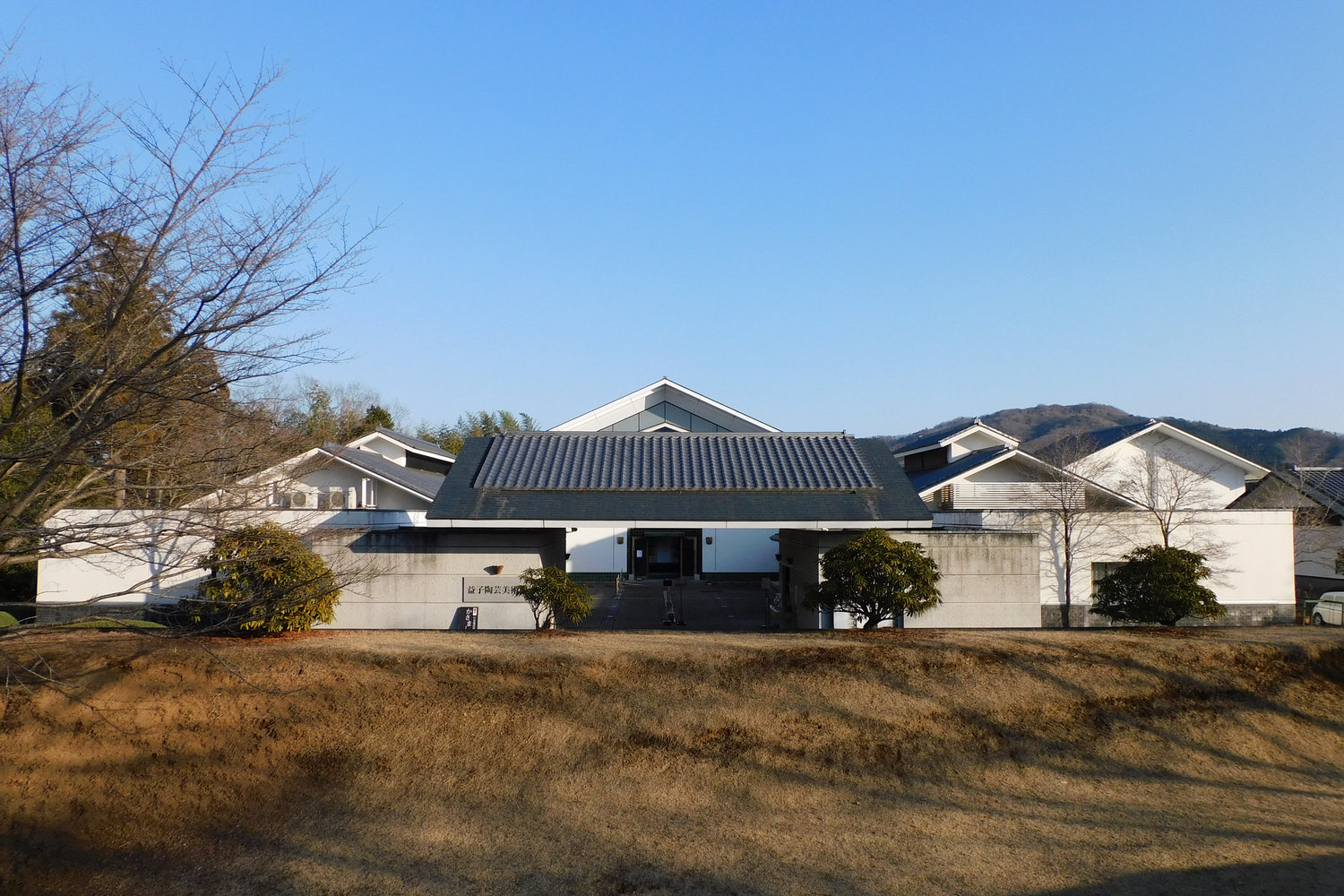
The Mashiko Museum of Ceramic Art, photographed in January 2023.
Night 1 — Mashiko
One option is Kominka Furuki, an old farmhouse guesthouse run by the Mashiko Tougei Club pottery studio. It shares an address with the studio, which makes for an easy start to the next morning's class. Its published rates are per person, room only: ¥4,500 per adult on weekdays and ¥5,000 on Fridays, weekends, public holidays and nights before holidays. Published rates do not mean a room is available on your night.
A few things to know before you choose it:
- Arrival: guests are asked to arrive by 5:00 p.m. Check-out is by 10:00 a.m. No earliest check-in time is published, so if you want to drop your bags before exploring, arrange it when you book.
- Rooms and facilities: there are eight Japanese-style rooms. Baths and toilets are shared, with separate men's and women's baths.
- What to bring: shampoo, conditioner and soap are provided, but bring your own pajamas, towel and toothbrush.
- Meals: none are included. Guests can use the kitchen and tableware. The studio says there are convenience stores and a supermarket nearby, so you can buy dinner and breakfast in town. Breakfast may be possible for some group sizes; ask when you book rather than counting on it.
- Wi-Fi: the studio's pages disagree on whether Wi-Fi reaches the guesthouse, so do not rely on it.
- Payment: at check-out, in cash or by card.
If you would rather have a conventional hotel room, private bathroom or a later check-in, look at other accommodation in Mashiko instead.
Day 2 — A wheel class, then across to Kasama
If working with clay is part of the reason you are going, make this the day.
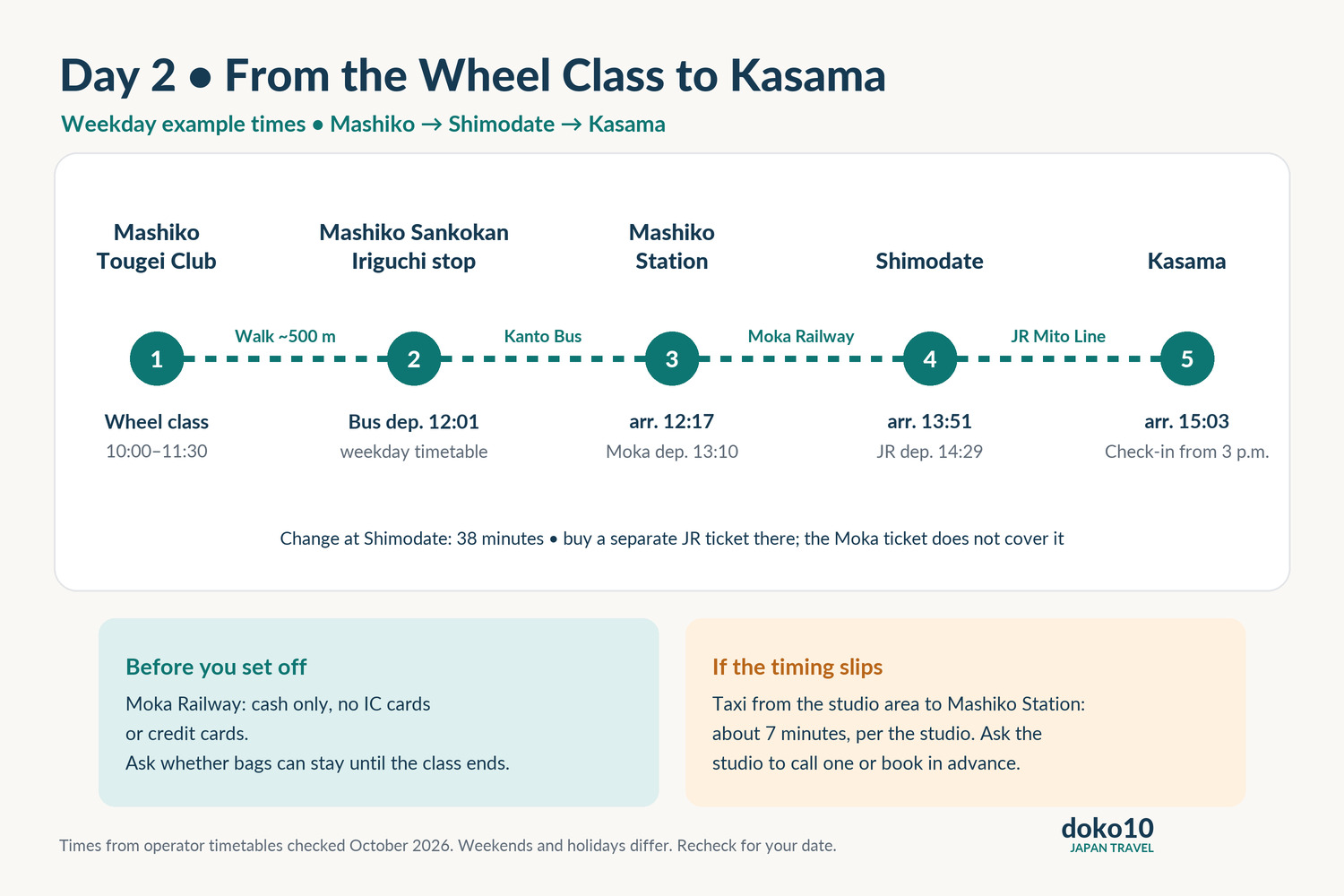
Mashiko Tougei Club offers a 90-minute wheel course, with a 10:00–11:30 a.m. session that fits this plan. The class is by reservation only, by phone or through the studio's email form, and you pay at the office when it ends.
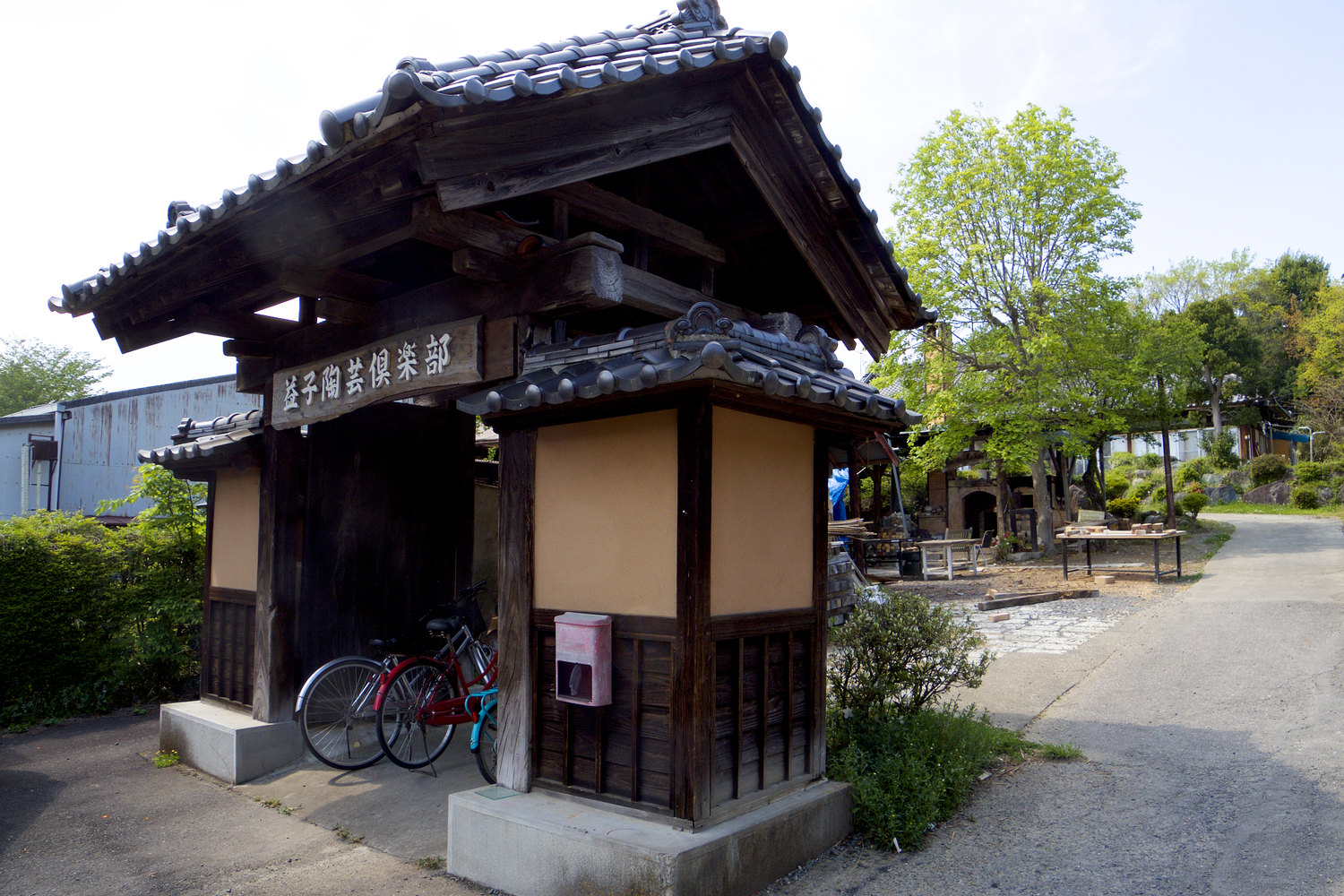
Mashiko Tougei Club's gate, photographed in 2016.
What the studio publishes about the price:
- Course fee: ¥5,500 including tax, covering facilities, materials and instruction. The page does not say whether this is per person or per booking, so confirm the total for two when you book.
- English instruction: an extra ¥2,200 for the 90-minute course. Again, the page does not say whether this is per person or per booking.
- Clay and pieces: you can use up to 3 kg of clay. The course listing says it comes with two pieces under 15 cm across and under 10 cm tall, and the studio fires the pieces you choose from what you made. Trimming and shipping cost extra.
- Firing: the page also lists firing as a separate cost, from ¥880 for one cup, and says firing and shipping are charged when work is sent by post. It does not explain how this charge relates to the two pieces that come with the course, so ask what firing will cost for the pieces you keep.
- Delivery: fired pieces are collected later or sent by post. Shipping starts at ¥2,200 for up to ten pieces; the page does not say which destinations that covers. It does not mention sending work abroad or give overseas rates. If you are leaving Japan soon after the trip, ask about delivery before you decide what to make.
- Cancellation: 50% of the fee from seven days to one day before, and the full fee on the day.
From the studio to the train
Check out of the guesthouse before the class. Ask when you book whether you can leave your bags there until the class ends.
On weekdays, Kanto Bus runs from Mashiko Sankokan Iriguchi to Mashiko Station. The useful departure is the 12:01 p.m. bus, which reaches the station at 12:17. The adult fare is ¥240. The stop is about 500 meters from the studio, so after an 11:30 finish you have roughly half an hour to pay, collect your bags and walk to the stop. The bus before it leaves at 10:25 and the next one at 1:31 p.m., which is too late for the train.
The 12:17 arrival leaves almost an hour before the 1:10 p.m. train. This plan does not check restaurants at Mashiko Station, so you may want to buy lunch at a convenience store in the morning.
If the timing slips, a taxi from the studio area to Mashiko Station takes about seven minutes according to the studio. Do not assume one will be waiting; ask the studio to call one or book it in advance.
Mashiko to Kasama by rail
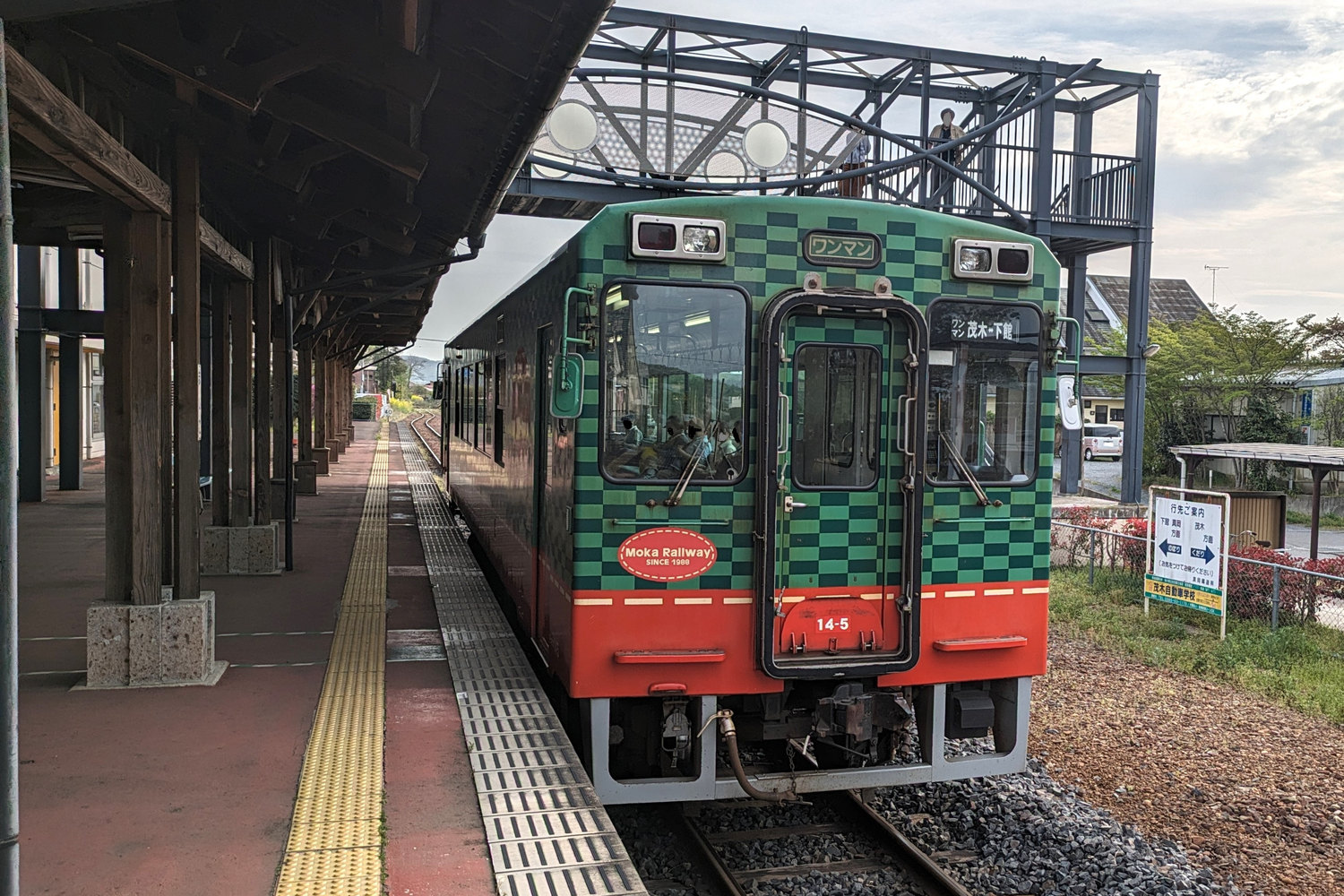
There is no need to go back through Tokyo. The Moka Railway and the JR Mito Line connect the two towns via Shimodate:
Swipe sideways or use arrow keys to view all columns and notes.
| Leg | Example times | Notes |
|---|---|---|
| Mashiko → Shimodate, Moka Railway | 13:10–13:51 | Adult fare ¥780. Pay in cash: the Moka Railway does not accept IC cards such as Suica or credit cards. |
| Shimodate → Kasama, JR Mito Line | 14:29–15:03 | Local train 751M. A 38-minute change at Shimodate. Buy a separate JR ticket; the Moka ticket does not cover it. |
These times come from the official timetables checked in October 2026. Both lines run infrequently, so recheck them close to your travel date.
Settle in rather than rush the museum
Kasama's town sightseeing bus links Kasama Station with Kasama Craft Hills and the Ibaraki Ceramic Art Museum. The museum closes at 5:00 p.m. with last entry at 4:30 p.m. On the example timetable, the 4:08 p.m. bus from Kasama Station reaches the Craft Hills / ceramics museum stop at 4:29 p.m. That is far too late for a proper visit.
Go to your hotel instead and leave the museum for a fresh start on Day 3.
Night 2 — Kasama
One possible base is Hotel Io Alpheratz, which describes itself as a five-minute walk from Kasama Geijutsu-no-Mori Park, the park that contains the ceramics museum and Craft Hills.
- Getting there: the hotel's FAQ gives about 20 minutes on foot or 5 minutes by taxi from Kasama Station. It has no shuttle. With luggage, a taxi is easier, but do not assume one will be waiting at the station.
- Check-in: from 3:00 p.m., so a 3:03 p.m. arrival at Kasama works.
- Dinner: by reservation only. If your room plan does not include dinner, book it in advance; same-day requests close at 6:30 p.m. at the front desk. The hotel's restaurant serves dinner 5:30–8:00 p.m. (last order 7:30). The nearest convenience store is about 15 minutes' walk away, according to the hotel.
- Breakfast: extra, served 7:00–9:00 a.m. (last order 8:30). Book it when you check in; it cannot be added on the morning itself.
- Wi-Fi: free in all rooms.
Room prices vary with booking date, room type and cancellation terms.
Day 3 — Kasama's ceramics museum, then Tokyo
Check out by 10:00 a.m. and leave your bags at the front desk. The hotel keeps luggage on the day of departure until you leave.
Start at the Ibaraki Ceramic Art Museum, which opens at 9:30 a.m. It normally closes on Mondays; when a Monday is a public holiday it opens that day and closes the next weekday instead. Admission depends on what is showing. Under the prices posted from April 2026, a general adult ticket costs ¥950 during a special exhibition (and covers every gallery) or ¥360 for the collection and theme exhibitions alone. Check what will be on during your visit.
Then walk over to Kasama Craft Hills, open 10:00 a.m.–5:00 p.m. and normally closed on Mondays (the next day after a Monday holiday). It is a relaxed place to browse Kasama ware without committing to a second class. If you do want another session, its wheel experience is listed at ¥4,800 from April 2026, painting at ¥2,100. Book separately, and do not assume English instruction or overseas delivery.
Getting back to Tokyo
Aim for the 1:05 p.m. JR Mito Line train from Kasama Station. How you reach the station depends on where your bags are:
- Bags already with you: take the sightseeing bus. The 12:29 p.m. bus from the Craft Hills / ceramics museum stop reaches Kasama Station at 12:48 p.m.
- Bags at the hotel, then on foot: plan to have your bags and be leaving the hotel by about 12:15 p.m. That is this plan's target, not a time set by the hotel. The hotel puts the walk to Kasama Station at about 20 minutes, which leaves a margin before the train. We have not checked the walk from the museum or Craft Hills back to the hotel. The park is large, so allow more than the five minutes the hotel quotes to the park, and work out when to leave the museum from there.
- Bags at the hotel, then by taxi: the front desk can arrange a taxi (about five minutes to Kasama Station), but warns that it may take time to arrive. Ask in advance rather than expecting one on the spot.
If you collect your bags at the hotel, plan on walking or a taxi. This plan does not assume you can get from the hotel to the 12:29 bus.
The hotel front desk can also ship luggage for you, cash on delivery only, if you would rather not carry it home.
JR East's timetables show these trains running on Thursday, November 19:
Swipe sideways or use arrow keys to view all columns and notes.
| Leg | Example times | Notes |
|---|---|---|
| Kasama → Tomobe, JR Mito Line | 13:05–13:14 | Local train 747M. |
| Option 1: Tomobe → Tokyo, Limited Express Tokiwa 70 | 14:03–15:14 | No change. Calls at Ueno at 15:07. You need a limited express ticket on top of the fare. Every ordinary-class seat on the Tokiwa is reserved, and there are no non-reserved cars. You can reserve a seat, or buy a seat-unspecified ticket (zaseki mi-shitei ken) for your date and section, at the same price. It lets you sit in any empty ordinary-class seat, but if the passenger holding that seat's reservation boards, you must move to another empty seat or stand in the vestibule. |
| Option 2: Tomobe → Tsuchiura → Tokyo, local trains | 13:20–14:09, then 14:35–15:49 | No limited express ticket needed. A 26-minute change at Tsuchiura. An earlier local leaves Tsuchiura at 14:12 and reaches Tokyo at 15:29, but with only three minutes to change, take it only if you actually make the connection. |
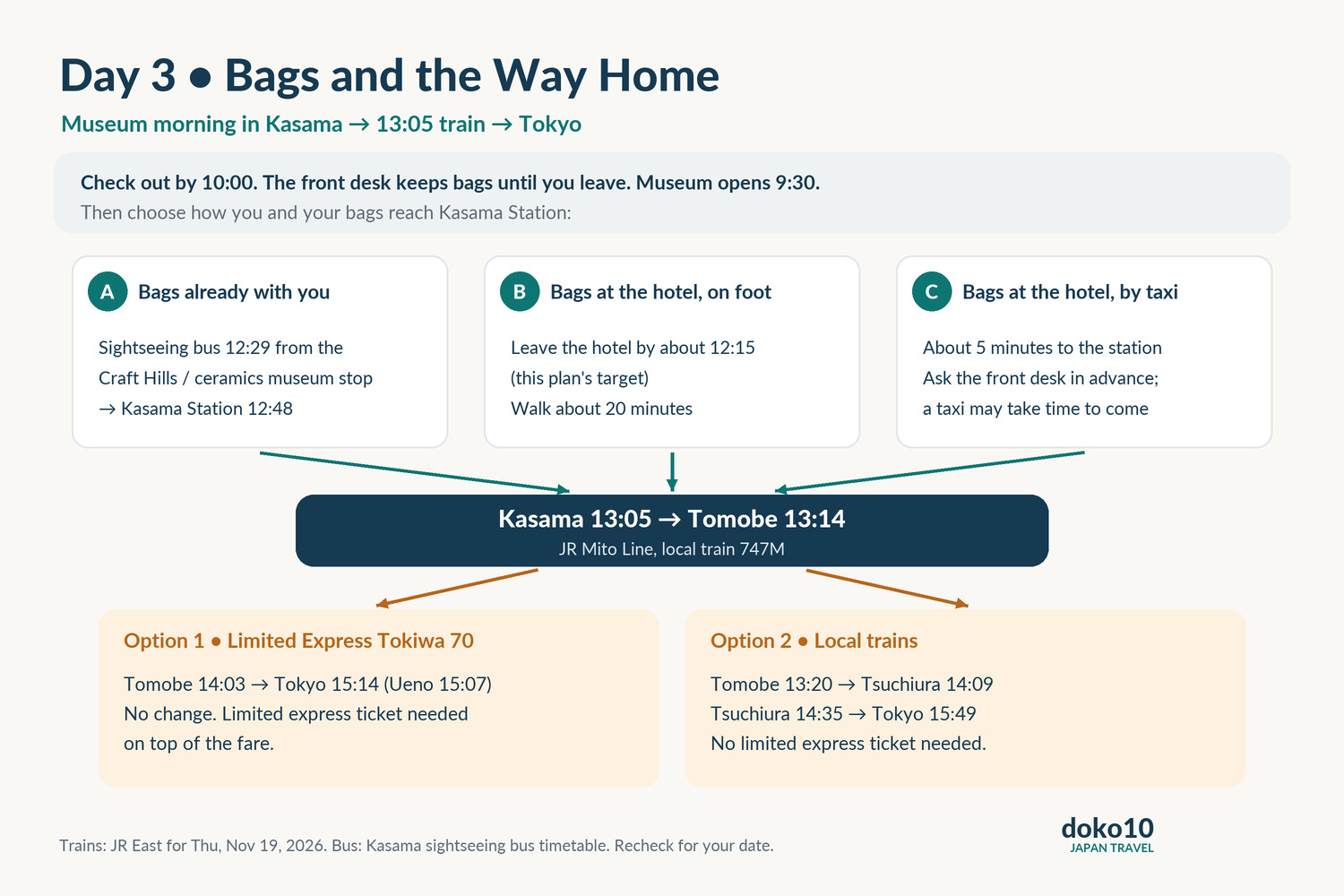
If you want a longer morning, later buses leave the Craft Hills / ceramics museum stop at 2:29, 3:29, 4:29 and 5:29 p.m. There is no bus between the 12:29 and 2:29 departures. Check the onward JR connection for any later bus before you rely on it.
Getting around Kasama
The Kasama city sightseeing bus is the backbone of a car-free visit:
- Route: a loop of about 40 minutes from Kasama Station, calling at stops including Kasama Geijutsu-no-Mori Park East Gate, Gallery Road and the Craft Hills / ceramics museum stop. There are seven departures a day from Kasama Station.
- Tickets: one-day passes only, valid on the day of purchase. ¥300 per person on ordinary weekdays; ¥500 on weekends, public holidays and the designated spring and autumn tourist seasons. Cash, credit cards and QR-code payment are accepted. If you ride on both Day 2 and Day 3, you need a separate pass for each day.
- Operating days: it normally does not run on Mondays (or on the following day when Monday is a holiday), but the published 2026 calendar has exceptions. On the example dates, November 17–19, 2026, the calendar shows the bus running at the ¥500 seasonal rate.
- Capacity: the city warns that you cannot board when the bus is full.
Always check the current timetable and calendar for your dates.
What does the trip cost?
This article does not give an all-in total. The rooms in Kasama, the JR journeys and the pottery class extras are the biggest unknowns. Below are the published prices this plan relies on, with the per-person basis stated where the source states it:
Swipe sideways or use arrow keys to view excluded and unconfirmed costs.
| Item | Published price (checked October 2026) | For two adults | Not included or not confirmed |
|---|---|---|---|
| Kominka Furuki, Mashiko (1 night) | ¥4,500 per adult on weekdays; ¥5,000 Fri/Sat/Sun, holidays and nights before holidays | ¥9,000 on a weekday night | Availability; meals |
| Kanto Bus, Utsunomiya Station West Exit → Mashiko Sankokan Iriguchi | ¥1,350 per adult | ¥2,700 | — |
| Mashiko Museum of Ceramic Art | ¥600 standard adult admission | ¥1,200 | Special-exhibition pricing |
| Mashiko Tougei Club, 90-minute wheel course | ¥5,500 listed; English instruction +¥2,200 | Not calculated | Whether either amount is per person or per booking; firing (from ¥880; how it relates to the two pieces that come with the course is not stated); trimming (price not published); shipping (from ¥2,200 for up to ten pieces; destinations not stated); overseas delivery and rates |
| Kanto Bus, Mashiko Sankokan Iriguchi → Mashiko Station | ¥240 per adult | ¥480 | Taxi fallback |
| Moka Railway, Mashiko → Shimodate | ¥780 per adult | ¥1,560 | — |
| Kasama sightseeing bus (Day 3, if used) | ¥500 one-day pass per person on the example dates (¥300 on ordinary weekdays) | ¥1,000 | A second pass if you also ride on Day 2; taxis |
| Ibaraki Ceramic Art Museum | ¥950 (special exhibition) or ¥360 (collection only), general adult | ¥1,900 or ¥720 | Exhibition schedule |
| Kasama Craft Hills wheel class (optional) | ¥4,800 | Not calculated | Per-person basis; language support; delivery |
Also not included: all JR fares (Tokyo → Utsunomiya, Shimodate → Kasama, Kasama → Tomobe → Tokyo), the Tokiwa limited express charge if you take it, the Hotel Io room, meals, taxis and any luggage shipping. This plan does not confirm the JR fare or limited express charge for each leg, so check them when you buy your tickets. Hotel prices change with the booking date, so compare current rates when you book.
Before you book: four checks
- Book the pottery class first if it matters to you, and settle the open points above: the total for two, firing and shipping for the pieces you keep, and delivery if you live abroad.
- Recheck the transport chain as a whole. The Day 1 and Day 2 buses, the 13:10 Moka Railway train, the JR Mito Line and the Kasama sightseeing bus all run infrequently. The Kanto Bus times above are weekday times.
- Plan your bags. Ask the Mashiko guesthouse about leaving bags during the class. In Kasama, decide before Day 3 whether you will carry your bags, or collect them from the hotel and walk or take a taxi.
- Mind museum closing days. Mondays, holiday substitutions and exhibition changeovers can disrupt the plan. Both museums announce irregular closures, such as November 4 in 2026.
Final recommendation
Mashiko and Kasama sit close together but have their own pottery traditions. A night in each gives you time to compare them, and a morning at the wheel lets you try making a piece yourself.
Keep the structure simple: one afternoon and one class in Mashiko, one evening and one museum morning in Kasama. Book the class early and recheck the few train and bus connections that hold the route together.
Photos from Wikimedia Commons: MashikoTohkoGaikan01 (FukuroWaraw / CC BY 4.0), Mashiko Museum of Ceramic Art, Jan. 2023 (Miyuki Meinaka / CC BY-SA 4.0; photographed in January 2023), 益子陶芸倶楽部・古民家古木 (salchuiwt / CC BY-SA 2.0; photographed in 2016), and Moka Railway 14-5 at Mashiko Station (Suikotei / CC BY 4.0). Each photo has been cropped to 3:2 and resized to 1500×1000; no other changes were made. The edited versions of the CC BY-SA photos are licensed under the same CC BY-SA license as their originals. Route and timetable diagrams by doko10.


