This is a desk-researched itinerary. I have not visited Iya or Oboke. It is a trip I would like to take, planned as seriously as if I were actually booking it. Prices and operating information were checked in September 2026, but please confirm the latest details on official websites before you travel.
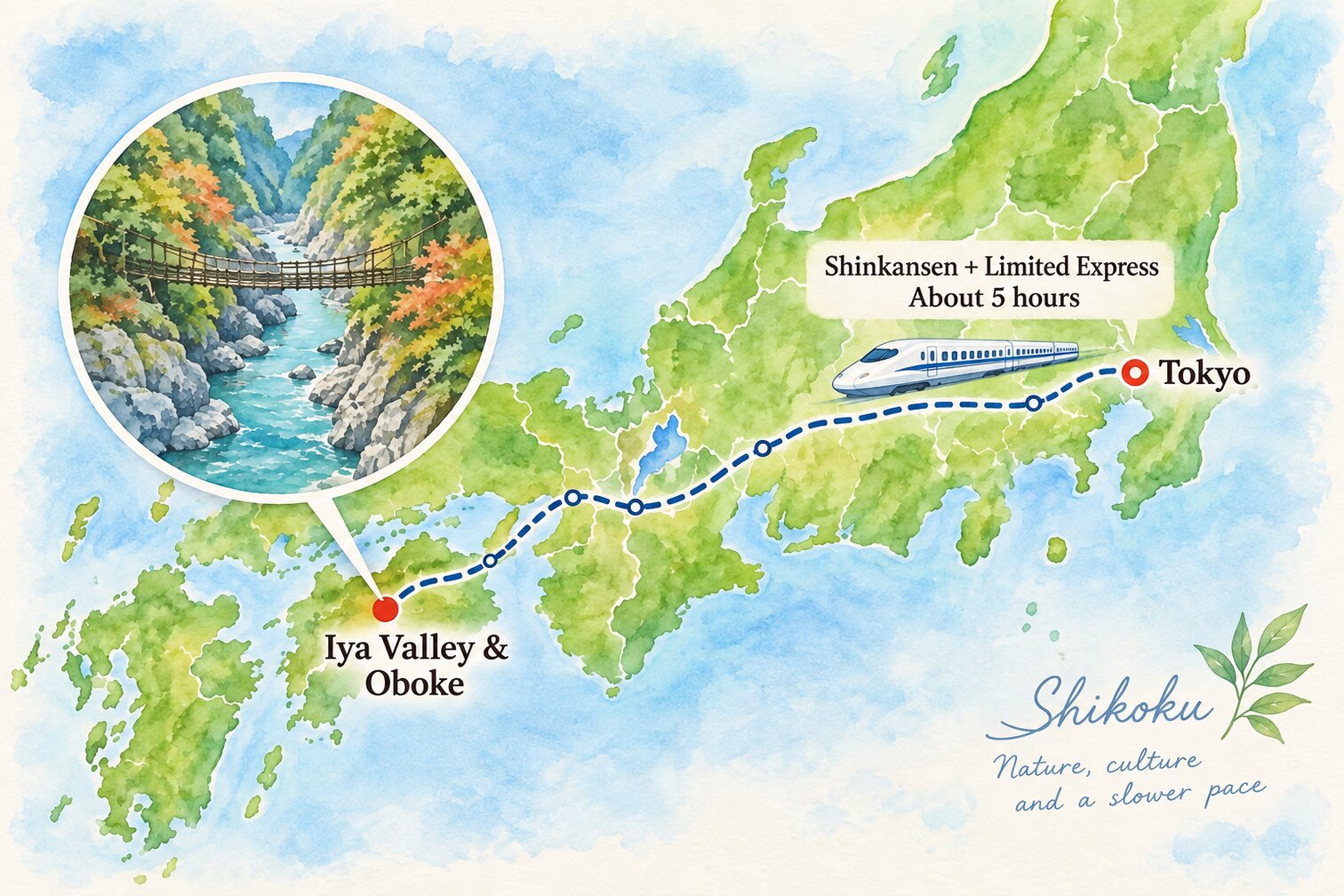
The plan at a glance
- Length: 2 days, 1 night from Tokyo, using the Shinkansen, a limited express, and local buses. No rental car.
- Destination: Oboke Gorge and Iya Kazurabashi in Miyoshi, Tokushima Prefecture.
- Day 1: Tokyo → Okayama → Limited Express Nampu to Oboke → gorge cruise → bus to the vine bridge → a hot-spring inn with a cable car to its open-air bath.
- Day 2: Morning bath → bus back to Oboke Station → Nampu and Shinkansen back to Tokyo.
- Best season: late October to mid-November, when the gorge turns autumn colors.
- Estimated cost: about ¥76,000 per person, based on two people sharing one room with dinner and breakfast included.
- Bottom line: you can do it without a car, but it becomes a trip built around the timetable.
Why Iya?
The fifth place that caught my attention while researching “where can you go on a set budget?” was the Iya Valley in Tokushima Prefecture. Shikoku had not yet appeared in the series, but the bigger reason was simple: I wanted to know whether this really works without a car.
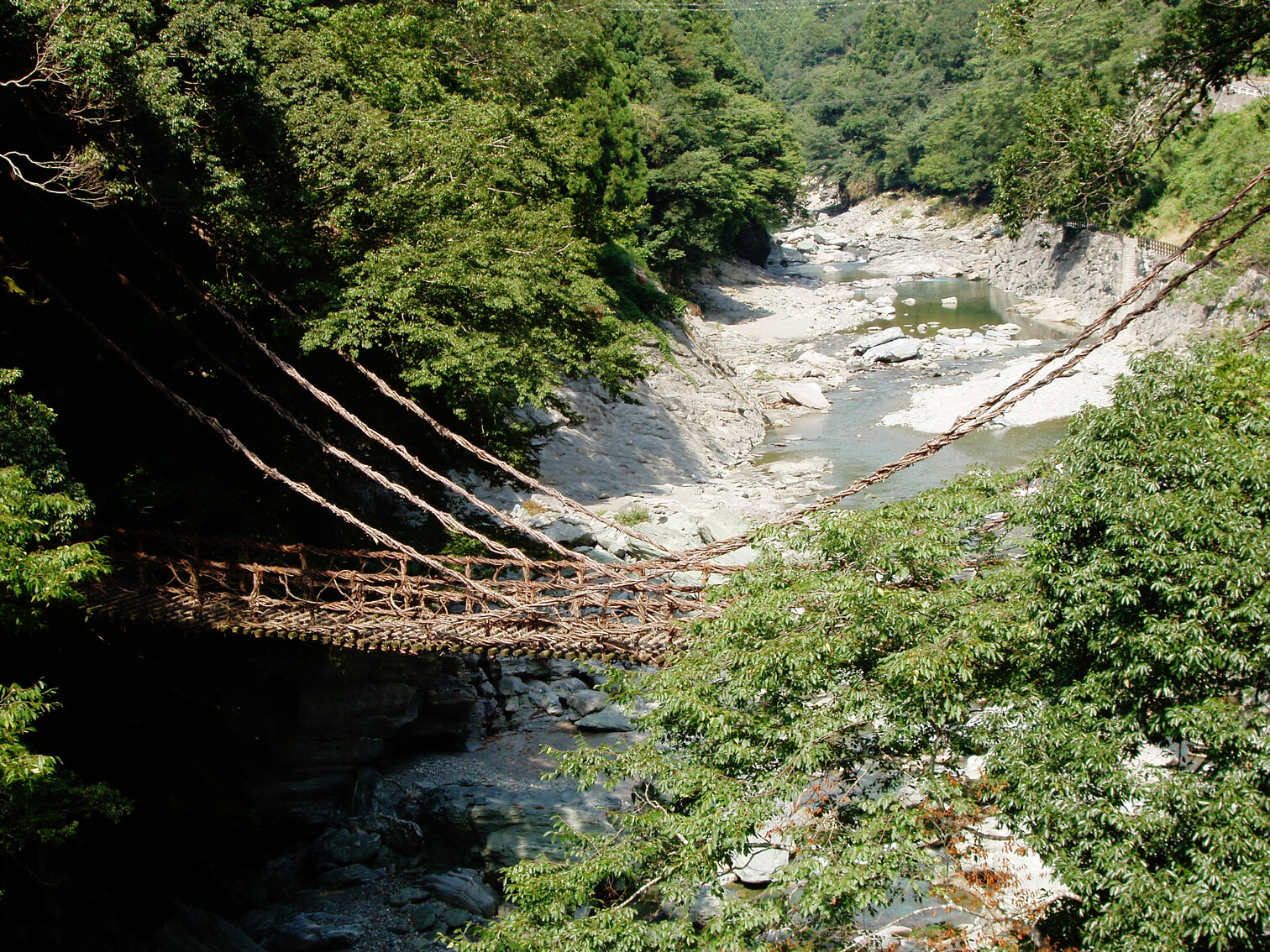
Iya is often described as one of Japan’s three great remote regions, alongside Shirakawa-go and Shiiba. It is also associated with legends of defeated Heike warriors who fled into the mountains. One story says the vine bridge was woven from shirokuchi-kazura vines so it could be cut down quickly if pursuers appeared. The bridge is 45 meters long, hangs 14 meters above the river, and is reportedly rebuilt every three years. Another draw is a hot-spring inn where a cable car descends from the building to an open-air bath projecting into the gorge.
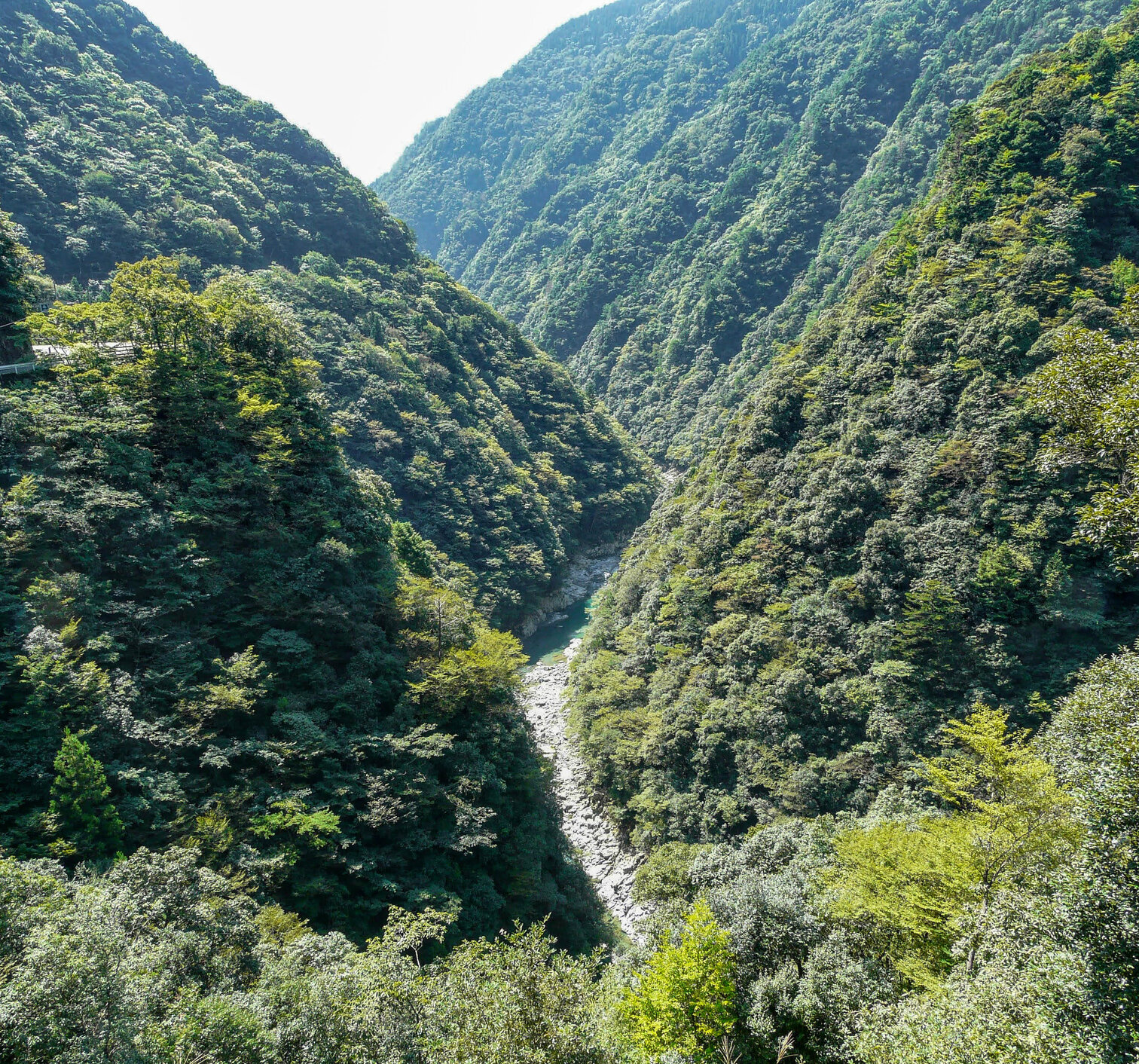
Most information about this part of Shikoku assumes you will have a rental car. So I checked the local bus frequency and hotel transfers to see what a car-free version would actually look like.
Getting there
- Tokyo → Okayama: about 3 hours 10 minutes by Nozomi, ¥17,770 for a reserved seat.
- Okayama → Oboke: about 1 hour 40 minutes by Limited Express Nampu, ¥4,270 unreserved or ¥4,800 reserved. The train crosses the Seto Ohashi Bridge and then follows the Yoshino River into the mountains.
- Oboke Station → Iya Kazurabashi: about 30 minutes by Shikoku Kotsu bus. Hotel Kazurabashi has a bus stop at its entrance and is about 20 minutes from the station.
Tokyo to Oboke takes about five hours with one transfer. That is only about an hour and a half longer than reaching Fukuyama for the Tomonoura trip. My first impression was that this “remote” destination is not quite as far away as the label suggests.
The difficult part starts after Oboke Station. The Iya Line has eight listed departures a day from Oboke Station: 8:58, 10:07, 11:08, 11:58, 13:10, 14:53, 16:08, and 17:08. Local buses stop at the entrance to Hotel Kazurabashi, so it does not offer a station shuttle. Hotel Iya Onsen, by contrast, has one pickup from Oboke Station at 15:10, reservation required. Miss those options and you are looking at a taxi, so the itinerary has to be built backward from the bus timetable.
Model itinerary: 2 days, 1 night
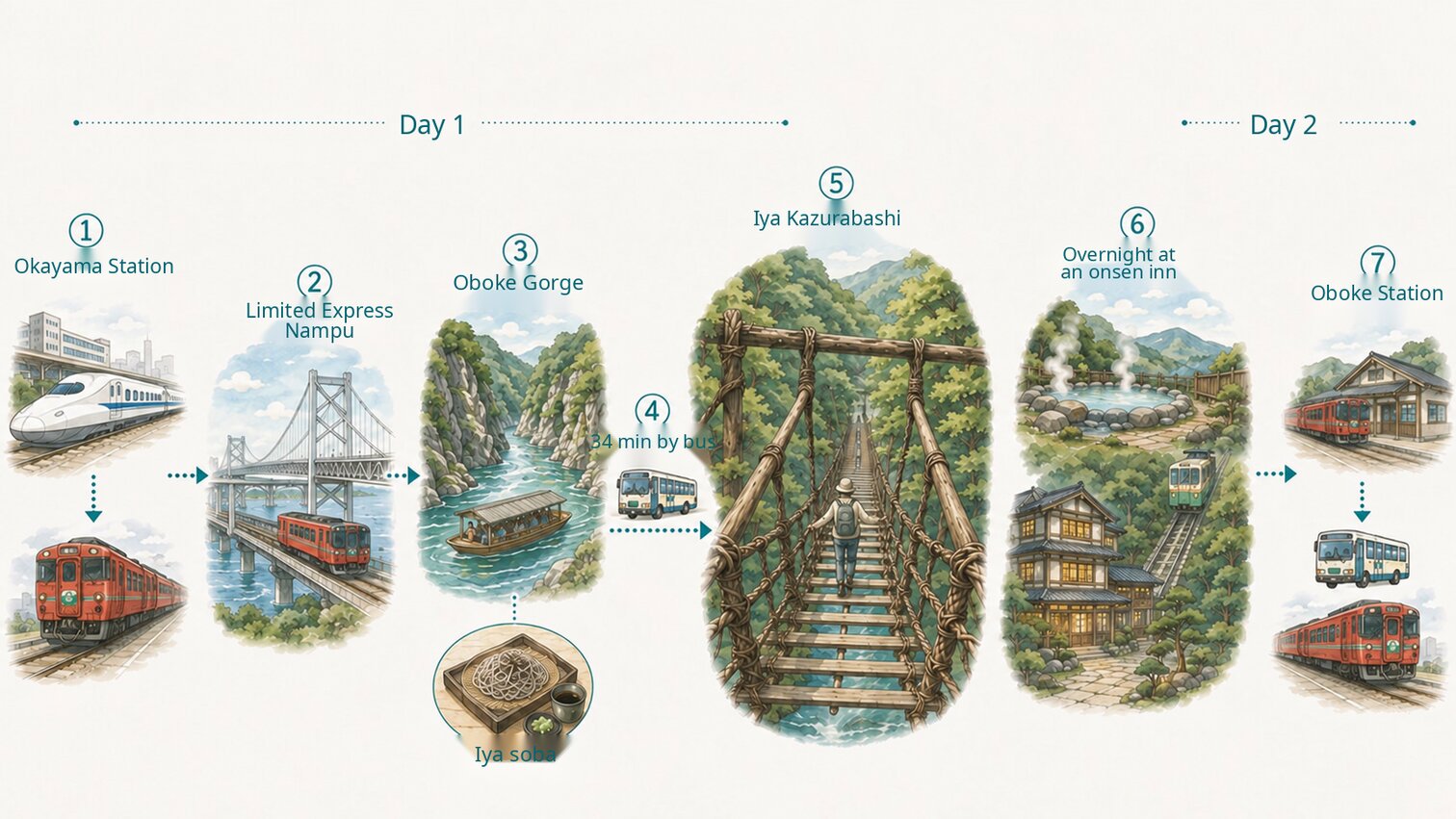
Day 1: The gorge by boat, the bridge on foot
Leave Tokyo before 7:00 on a Nozomi and change to a Nampu in Okayama in the 10 o’clock hour. That puts you in Oboke before noon. The scenery on the Nampu reportedly becomes much more mountainous after Awa-Ikeda, so I would want a seat on the left side in the direction of travel.
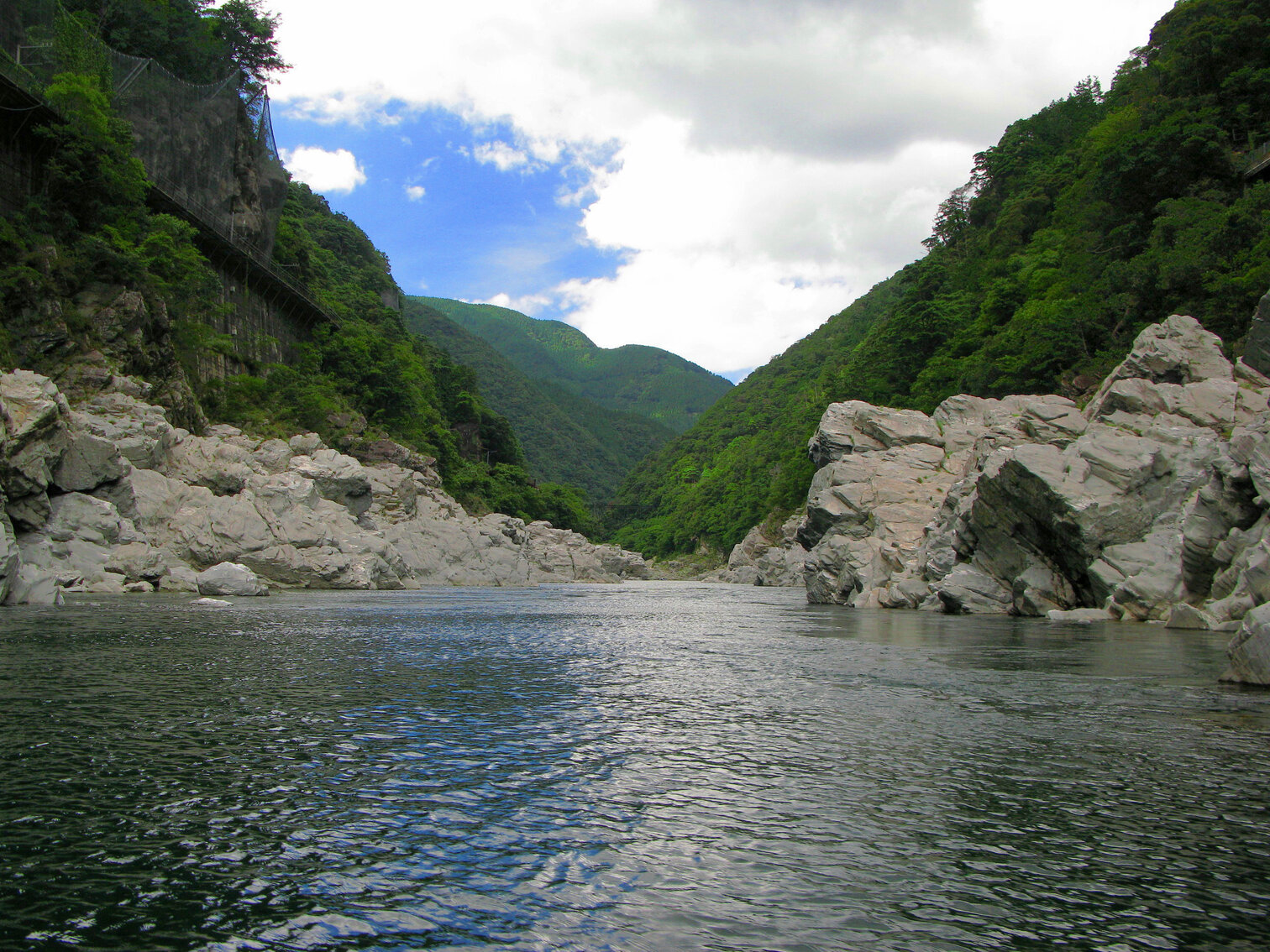
First stop: the Oboke Gorge sightseeing boat. The boarding point is about a 30-minute walk along the national highway from the station, or about five minutes by bus to the “Obokekyo” stop. The boat makes a roughly 30-minute round trip through a gorge said to have been carved by the Yoshino River over 200 million years. The adult fare is ¥1,800 and reservations are not required. For lunch, the plan is Iya soba at the restaurant by the boat landing: thick, short noodles made with relatively little binding flour.
In the afternoon, take the 13:04 bus from the “Obokekyo” stop in front of the cruise area to Kazurabashi Yumebutai, arriving at 13:38. The fare is ¥730. The vine bridge is one-way, and through the gaps between the slats you can apparently see the river 14 meters below. Just beyond it is Biwa Waterfall, which is free to visit. A local legend says Heike fugitives played the biwa there while remembering the old capital.
My first lodging choice is Hotel Kazurabashi, which is also listed on Rakuten Travel. It is close to the vine bridge and has its own cable car up to the “Tenku Rotenburo” open-air bath. Dinner includes local Iya dishes such as salt-grilled ayu served around an irori hearth. I found dinner-and-breakfast plans from ¥45,100 for two people. If there is room in the budget, another option is Hotel Iya Onsen, a standalone inn built on the gorge. Its cable car goes down to an open-air bath by the valley floor, where the free-flowing spring water is said to be a mild 39°C and may contain visible mineral deposits. Plans were listed from ¥68,200 for two.
Day 2: A morning bath, then back the way you came
Start with another cable-car ride to the open-air bath. A mountain morning like that feels like a destination in itself.
After checking out, take the 9:13 bus from the stop in front of the hotel and arrive at Oboke Station at 9:34. From there, the Nampu and Shinkansen can get you back to Tokyo by evening.
If time allows, there is another option: take the 10:37 bus to Hotel Iya Onsen, arriving at 10:52, and use the day-use bath. The cable-car ride down to the open-air bath costs ¥1,900 for adults, and reception is from 7:30 to 16:00. The 13:52 bus returns to Oboke Station at 14:39. Staying at one inn and bathing at another would be an indulgent way to use the second day. Day-use bathing does have closure dates, though, and the hotel publishes a monthly calendar, so that needs to be checked once the travel date is fixed.
Estimated cost per person
Assuming two people share one room:
- Shinkansen: Tokyo ⇔ Okayama round trip, ¥35,540, regular-season reserved Nozomi seats.
- Limited Express Nampu: Okayama ⇔ Oboke round trip, ¥8,540 unreserved, or ¥9,600 reserved.
- Bus: Oboke Station ⇔ Iya Kazurabashi round trip, about ¥1,400.
- Lodging: Hotel Kazurabashi with dinner and breakfast, about ¥23,000 per person, based on plans from ¥45,100 for two.
- Gorge cruise and vine bridge: ¥2,350 total, made up of ¥1,800 for the cruise and ¥550 for the bridge.
- Two lunches and incidentals: ¥5,000.
Total: about ¥76,000
The Shinkansen and limited express alone come to about ¥44,000, roughly 60% of the budget. Even so, there is still more than ¥20,000 of room under ¥100,000. Upgrading the stay to Hotel Iya Onsen adds about ¥11,000 per person, bringing the trip to roughly ¥87,000. That is close to the Tomonoura trip’s roughly ¥74,000 budget, but this time the destination is a place commonly described as a “remote region.”
Prices are based on information checked in September 2026. Accommodation prices vary by date and plan.
When to go
Autumn is the standout season for Iya and Oboke. The gorge usually colors from late October through mid-November, so you can see the autumn foliage from both the sightseeing boat and the vine bridge. The most appealing version of this trip would be soaking in an open-air bath while looking over an autumn gorge. Buses and hotels are likely to be busy at that time, so a timetable-driven trip like this is one to reserve early. Fresh green foliage in April and May is another option if you want to avoid autumn.
What I still do not know
This is a desk-researched itinerary, so I want to be clear about what I could not fully confirm.
After publication, I checked the April 2026 Shikoku Kotsu timetable, the official sites for the Oboke Gorge attraction and Hotel Iya Onsen, and route-search information again. That let me confirm the Nampu fare, cruise fare, bus times, the distance to the hotel, and the day-use bathing details that were initially uncertain. There are also two corrections to the first draft. I originally wrote that “the hotel shuttle leaves only once, at 15:10,” but that applies to Hotel Iya Onsen. Hotel Kazurabashi, my first choice, has no station shuttle because the local bus stops at its entrance. The sightseeing boat fare also increased to ¥1,800 on September 1, 2026.
A few things remain unresolved:
- The bus fare from Oboke Station to the sightseeing-boat stop. The fare from Obokekyo to Kazurabashi Yumebutai is ¥730, but I have not confirmed the station-to-gorge fare.
- The exact Nampu departure from Okayama and arrival time at Oboke. This plan assumes arrival before noon, but the specific train determines whether the 13:04 bus after the cruise is realistic.
- Timed road restrictions are sometimes announced on the Iya road, including in September 2026, and I have not confirmed whether they affect bus operations.
This plan depends on checking the timetable more than the other four plans I had researched by this point, so I would rebuild it once more before actually going.
Conclusion
About five hours from Tokyo with one transfer, then one of Japan’s often-described great remote regions: cross the vine bridge and take a cable car to an open-air bath. Estimated cost: about ¥76,000 per person.
It works without a car. But with so few buses and tightly constrained hotel access, this is not a trip where you move whenever you like. It is a trip where you move when the timetable lets you. Some people will see that as a nuisance; I think it is part of the appeal, so I would take the plan as it stands.
If I make the trip, I will write the reality check afterward.
Photos from Wikimedia Commons: Tokushima Miyoshi Oboke Gorge Of Yoshino River 2(京浜にけ / CC BY-SA 3.0), Iya Valley a(Yamato / CC BY-SA 3.0), and Iya Valley seen from the Iya Valley Observatory 001(Naokijp / CC BY-SA 4.0). Resized only. Illustrations are for reference.


Estimated cost per person, based on two people sharing one room
- Shinkansen Tokyo ⇔ Okayama round trip: ¥35,540
- Limited Express Nampu Okayama ⇔ Oboke round trip: ¥8,540
- Bus Oboke Station ⇔ Iya Kazurabashi round trip: about ¥1,400
- Lodging at Hotel Kazurabashi, dinner and breakfast included: about ¥23,000
- Gorge cruise and vine-bridge admission: ¥2,350
- Two lunches and incidentals: ¥5,000
- Total: about ¥76,000 (about ¥87,000 with Hotel Iya Onsen)