This is a researched itinerary, not a first-hand trip report. Prices and opening information were checked in September 2026. The early-spring hotel benchmark uses public, non-member rates for four-night stays in February and March 2027; member-only discounts are excluded. Recheck fares, opening days, workshop availability and hotel prices before booking.
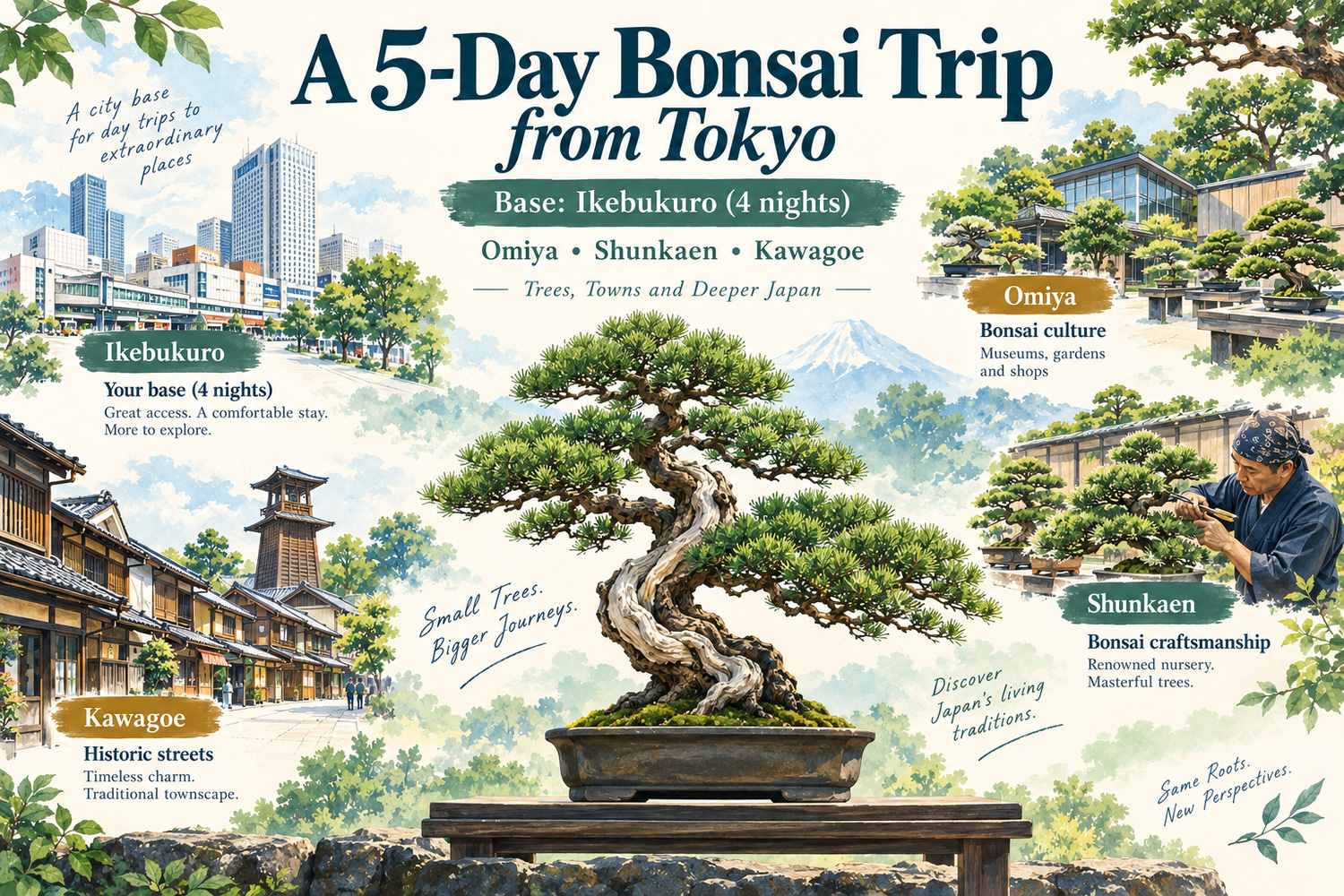
If bonsai is one of the reasons you want to visit Japan, you do not need to turn the whole trip into a museum marathon.
This plan keeps one hotel in Ikebukuro for four nights, spends a full day in Omiya's bonsai district, adds a hands-on option at Shunkaen in eastern Tokyo, and uses Kawagoe as a change of pace. The first and last days stay deliberately light because international arrival and departure times vary too much to build around.
The result is a five-day trip that is clearly about bonsai without being five straight days of bonsai.
The trip at a glance
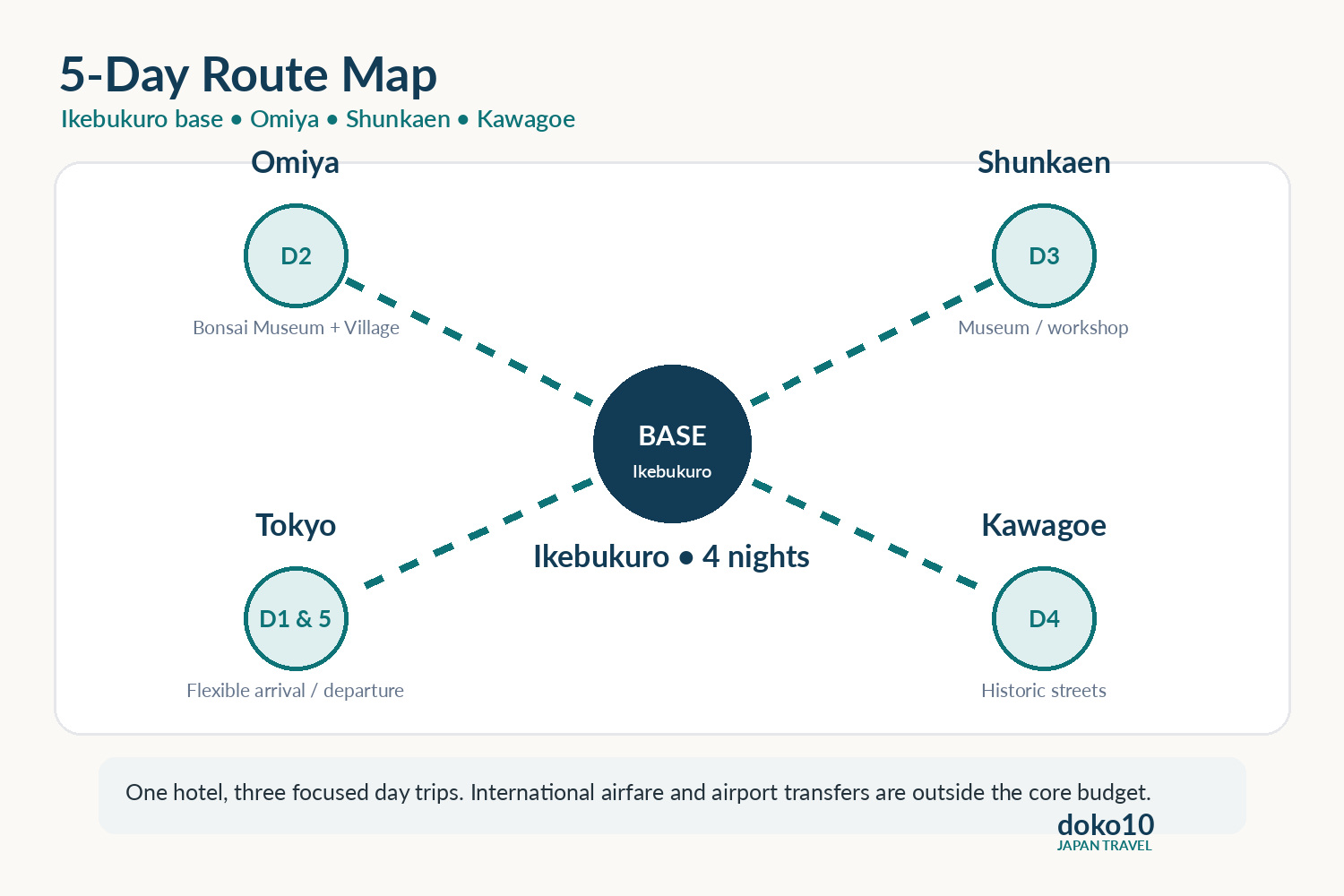
- Day 1: Arrive in Tokyo and check in around Ikebukuro.
- Day 2: Omiya Bonsai Art Museum and Omiya Bonsai Village.
- Day 3: Shunkaen Bonsai Museum, with an optional bonsai workshop.
- Day 4: Kawagoe: Kitain, the old warehouse district, Toki no Kane and Hikawa Shrine.
- Day 5: Keep Tokyo flexible, then depart.
For two adults sharing one room, an early-spring version of the trip comes to roughly ¥118,000–¥214,000 for two before international airfare, depending mainly on the hotel level. A Shunkaen workshop adds about ¥22,400 for two compared with the visit-only version.
International flights, airport transfers, shopping, alcohol and Tokyo's accommodation tax are not included in those headline figures.
Why stay in Ikebukuro for all four nights
There is no need to move hotels for this route.
Ikebukuro works well for Omiya and especially well for Kawagoe, while still giving you normal Tokyo transport for the rest of the trip. Shunkaen is the one cross-city day, but changing hotels just to shorten that journey would make the itinerary more complicated than it needs to be.
For a four-night stay, I would compare four kinds of hotel rather than chase the cheapest room on one particular night:
- Value: Hotel Resol Ikebukuro
- Standard: DEL style Ikebukuro Higashiguchi
- Long-stay comfort: Tokyu Stay Ikebukuro
- Premium: Hotel Metropolitan Tokyo Ikebukuro
Tokyu Stay is worth treating separately from a simple price ladder. Its appeal is the longer-stay setup rather than luxury positioning.
Day 1 — Arrive in Tokyo and keep the schedule light
Do not make an international arrival day do too much work.
Check into the Ikebukuro hotel, eat nearby and recover from the flight. If you arrive early and still want to go somewhere, a garden such as Rikugien is a sensible optional stop. But it should stay optional.
This itinerary is stronger when the first required activity starts the next morning.
Day 2 — Omiya: museum first, then the bonsai village
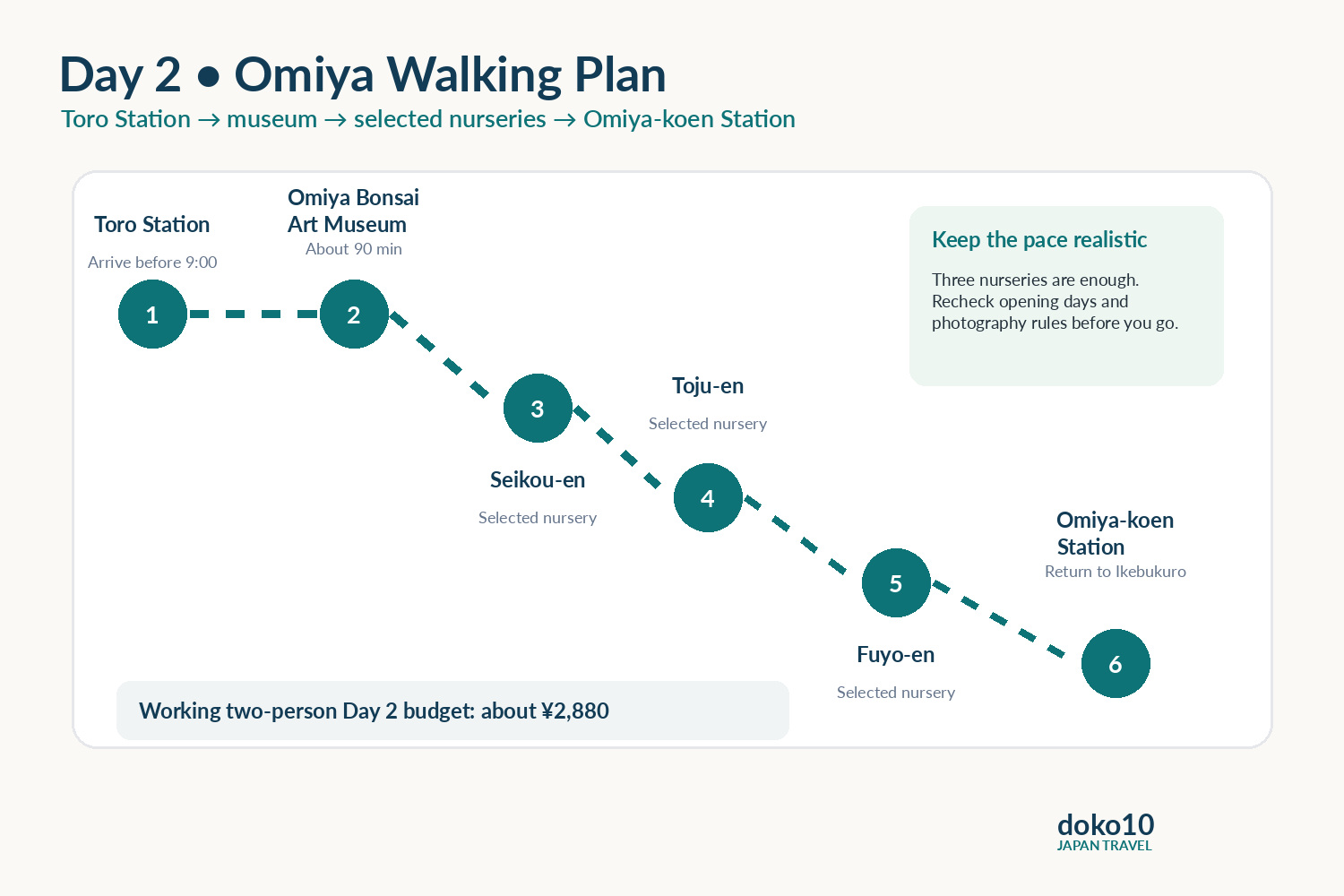
Leave Ikebukuro at around 8 a.m. and aim to reach Toro shortly before the museum opens.
The Omiya Bonsai Art Museum is the best place to start because it gives you context before you walk into the working bonsai district. When checked in September 2026, adult admission was ¥310. Opening hours were 9:00 a.m.–4:30 p.m. from March through October and 9:00 a.m.–4:00 p.m. from November through February, with Thursdays normally closed.
Allow roughly 90 minutes.
From there, walk through Omiya Bonsai Village rather than trying to turn the day into a checklist. A practical sequence is Seikou-en, Toju-en and Fuyo-en, with lunch and a break in between. Three nurseries are enough to see different approaches without rushing from gate to gate.
Finish toward Omiya-koen Station instead of walking all the way back to Toro. It makes the day a one-way walk and costs only slightly more than retracing the route.
For two people, the working Day 2 budget is about ¥2,880, including transport and museum admission.
Nursery access can change more easily than museum hours. Recheck opening days and photography rules before you go, and do not assume that every garden can be photographed.
Day 3 — Shunkaen: visit the museum or make bonsai yourself
Shunkaen is the one day that crosses Tokyo from west to east.
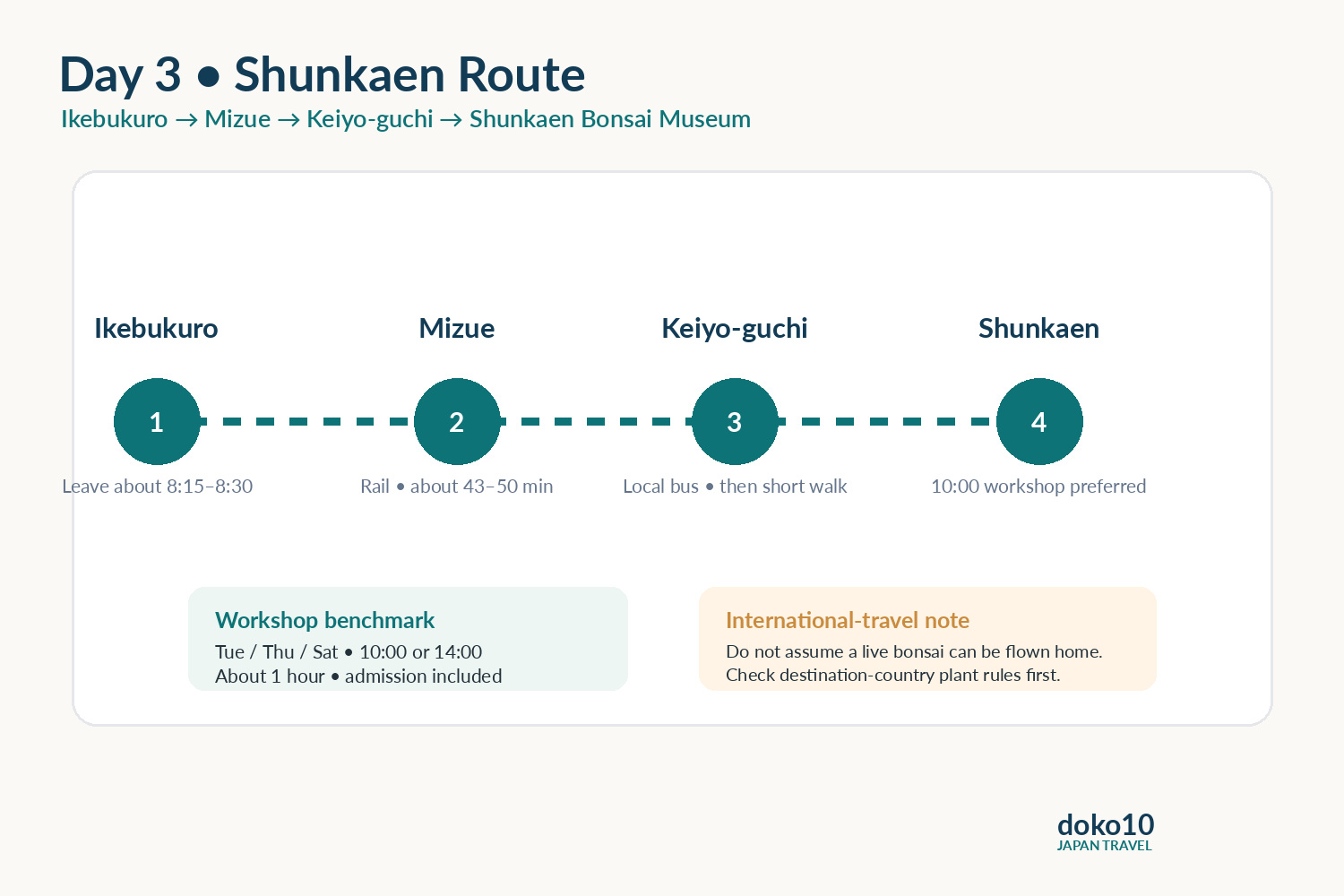
A workable route is Ikebukuro → Mizue → local bus to Keiyo-guchi, followed by a short walk to the museum. Leave Ikebukuro around 8:15–8:30 a.m. if you have booked the 10:00 workshop.
At the time of research, Shunkaen Bonsai Museum charged ¥2,000 per person for admission.
The bonsai workshop was offered on Tuesdays, Thursdays and Saturdays at 10:00 a.m. and 2:00 p.m. It lasted about one hour, cost ¥12,000 per person plus tax, included museum admission, and needed to be booked at least four days in advance. With the standard Tuesday-to-Saturday trip shape used here, Day 3 falls on Thursday. If you are visiting without the workshop, still recheck Shunkaen’s opening calendar for your dates.
For this itinerary, the 10:00 session is the better default. You can do the workshop first, spend more time looking around afterward and leave when you are ready. If 10:00 is full, the 2:00 p.m. session is a workable backup.
If you skip the workshop, give the museum roughly two to two and a half hours and keep the afternoon free.
For two people:
- Visit only: about ¥6,480 including transport and admission.
- Workshop: about ¥28,880 using the tax rate assumed in the September 2026 research.
Do not assume you can take a live bonsai home
A workshop souvenir is not the same thing as an ordinary souvenir.
Plant-import rules vary by destination, and many countries restrict plants, soil or both. Before treating any live bonsai as something you can fly home with, check the import rules for your destination and the current Japanese export/quarantine guidance.
Japan's Plant Protection Station has an English export FAQ.
Day 4 — Kawagoe: give your eyes a break from bonsai
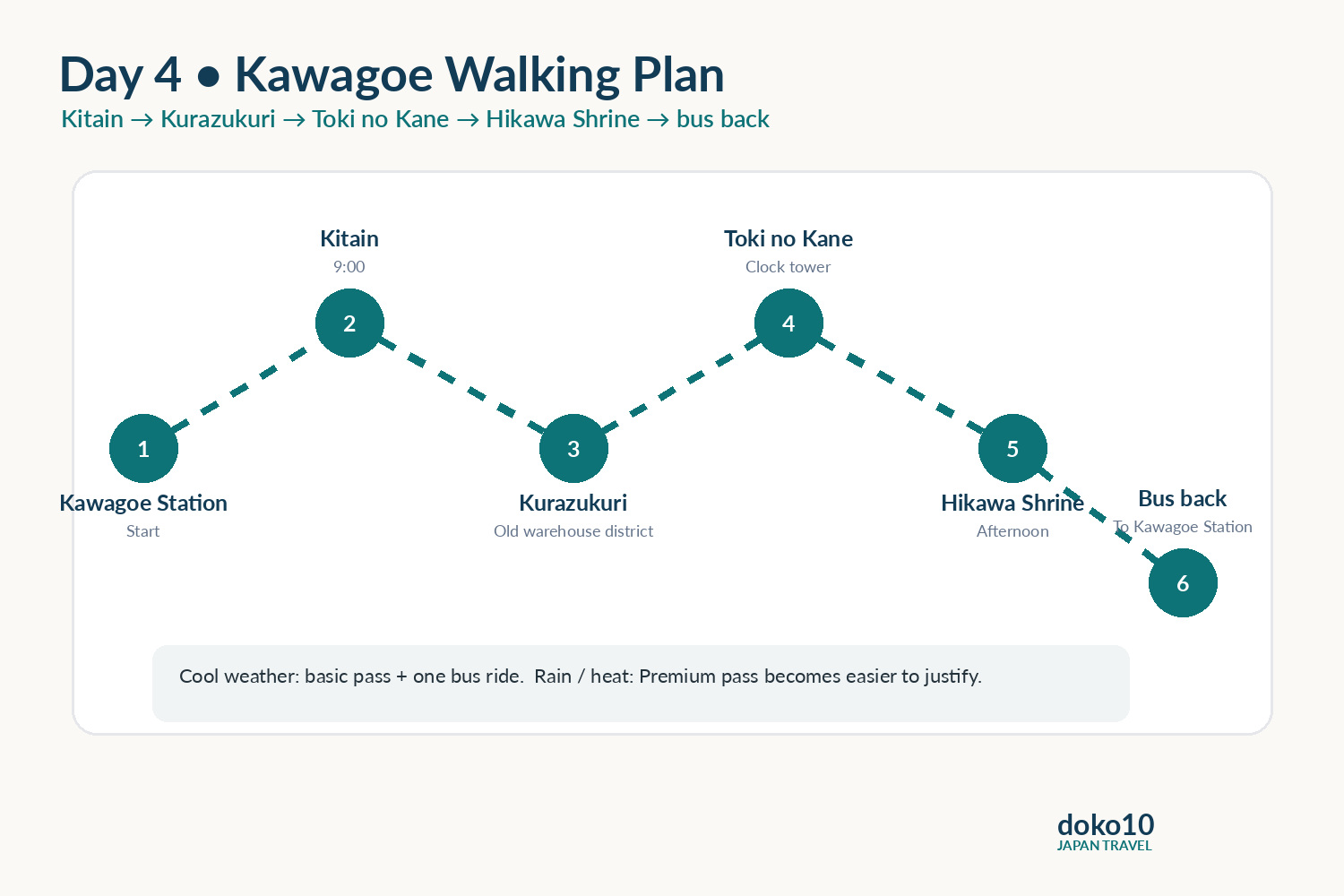
After two bonsai-heavy days, Kawagoe works because it changes the subject without breaking the trip.
Leave Ikebukuro around 8 a.m. and start with Kitain at about 9 a.m. From there, walk toward the Kurazukuri warehouse district and Toki no Kane, stop for lunch, then continue toward Kawagoe Hikawa Shrine.
This is mostly a one-way walking day. Take a bus back to Kawagoe Station from the shrine rather than retracing the whole route.
For overseas visitors, Tobu's Kawagoe passes can be useful. At the time of research, the ordinary KAWAGOE DISCOUNT PASS was ¥710 per adult. The live Premium pass, which includes designated local buses, was ¥1,200 per adult.
In cool weather, the basic pass plus a single bus ride is enough for this itinerary. In rainy or very hot weather, the Premium version is easier to justify because you are more likely to use buses repeatedly.
The working Day 4 budget is about ¥2,680 for two, including the ordinary pass, one return bus ride from the shrine area and Kitain admission.
Day 5 — Keep the last day flexible too
The last day should work with your flight, not against it.
If you have a late departure, use the morning for another Tokyo museum or garden. Tokyo National Museum is an obvious option if you want to stay with Japanese art and material culture. If your flight is earlier, skip the extra sightseeing and leave for the airport.
That is why Day 5 admission and airport transport are not in the headline budget.
How much does the trip cost?
The budget below uses an early-spring hotel benchmark from two four-night stays: February 16–20 and March 9–13, 2027.
The hotel comparison used two adults, one room, room-only pricing and public/non-member rates. Membership-only discounts such as Booking.com Genius were not used as the standard benchmark. Flexible cancellation was preferred.
Tokyo accommodation tax is shown separately rather than buried in the hotel number.
Visit-only version
| Stay style | 4-night hotel benchmark | Trip total for two |
|---|---|---|
| Value | ¥60,600–¥62,600 | about ¥118,000–¥120,000 |
| Standard | ¥90,200–¥95,400 | about ¥148,000–¥153,000 |
| Long-stay comfort | ¥106,575–¥117,180 | about ¥164,000–¥175,000 |
| Premium | ¥120,400–¥156,400 | about ¥178,000–¥214,000 |
With the Shunkaen workshop
| Stay style | Trip total for two |
|---|---|
| Value | about ¥140,000–¥142,000 |
| Standard | about ¥170,000–¥175,000 |
| Long-stay comfort | about ¥186,000–¥197,000 |
| Premium | about ¥200,000–¥236,000 |
The workshop adds about ¥22,400 for two compared with the visit-only plan.
The non-hotel model behind these totals is about ¥57,440 for two in the visit-only version and ¥79,840 with the workshop. That includes the three core sightseeing days and a standard food allowance of about ¥45,400 for two.
It does not include international airfare, airport transfers, shopping, alcohol, optional Day 1/Day 5 paid sights or Tokyo accommodation tax.
Hotel prices move. Check the hotel's own site as well as the major booking sites before paying; early-booking or promotional rates can be lower than the benchmark.
When should you take this trip?
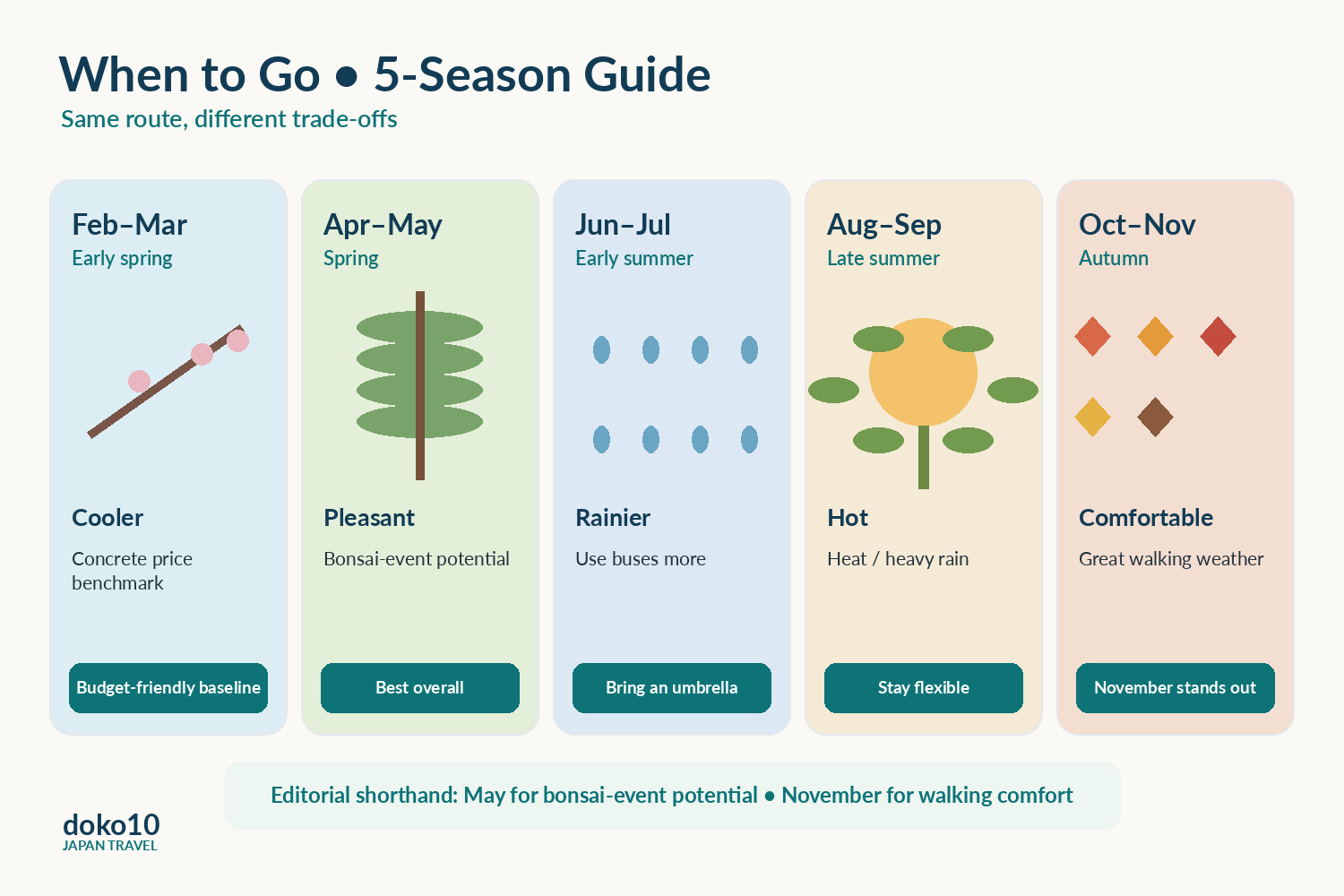
There is no single month that wins every category.
February–March: cooler and easier to budget
This is the season for which I have the most concrete hotel benchmark.
It is cooler, the walking days are less physically demanding than summer, and the route works without depending on a seasonal event.
April–May: strongest all-round choice
For a bonsai-first trip, spring is hard to ignore.
May has repeatedly brought major bonsai events to Omiya, including the large Omiya Bonsai Festival in recent years. Do not assume the same dates will repeat in 2027 or 2028; check the current Saitama City and museum calendars.
If bonsai events matter more to you than the lowest room rate, May is the first month I would investigate.
June–July: rainier, but still workable
The itinerary does not collapse in the rainy season, because the museum and Shunkaen give you indoor time.
The weak points are the walking sections in Omiya and Kawagoe. Keep those days flexible, use buses more readily and do not force the full walking route in heavy rain.
August–September: for travelers who handle heat well
The route still works, but it becomes more weather-sensitive.
Start outdoor days early, shorten walks when necessary and use the Premium Kawagoe pass if you expect to rely on buses. September also deserves schedule flexibility for heavy rain and tropical-weather disruptions.
October–November: excellent for walking
Autumn deserves its own category.
October is mild but can still be relatively wet. November is cooler and generally much easier for a walking-heavy itinerary. If your priority is comfortable days in Omiya Bonsai Village and Kawagoe rather than a specific bonsai event, November is one of the strongest choices.
My shorthand would be:
- May: best place to start if bonsai events are the priority.
- November: best place to start if walking comfort is the priority.
How far ahead should you book?
For this itinerary, planning about four to six months ahead is a sensible working model.
That gives you time to compare public hotel rates and decide whether the Shunkaen workshop matters enough to book around. Closer to departure, recheck the details that can actually change: operating calendars, workshop availability, train and bus schedules, hotel cancellation terms and seasonal events.
Do not treat a hotel price captured months earlier as a promise.
A note on Tokyo's accommodation tax
Tokyo's accommodation-tax rules change on April 1, 2027.
For stays from that date, accommodation priced at ¥13,000 or more per person per night is subject to a 3% accommodation tax under the revised system. The stay date, not the reservation date, determines which system applies.
Because of that change, the Early Spring hotel table above does not simply carry forward unchanged into the April–November versions of the budget.
Recheck the Tokyo Metropolitan Government guidance for your dates.
What to recheck before you go
This itinerary is deliberately built from places that are practical to combine, but several details should never be treated as permanent:
- Omiya Bonsai Art Museum opening days and temporary closures
- opening/access rules at individual bonsai nurseries
- Shunkaen admission, workshop schedule, workshop price and booking method
- plant-quarantine rules if you want to buy a live plant
- rail and bus fares and timetables
- Kawagoe pass prices
- Kitain opening information
- Tokyo accommodation tax
- annual bonsai event calendars
- hotel prices and cancellation terms
The route itself is durable. The operational details are the part to refresh.
Final recommendation
For a first bonsai-focused Japan trip, I would keep the structure simple: four nights in Ikebukuro, one full Omiya day, one Shunkaen day and one Kawagoe day.
Choose the visit-only version if you mainly want to see strong collections and keep the trip around the lower end of the budget.
Choose the workshop version if making bonsai is part of the reason you are coming to Japan in the first place.
Then choose your season based on what matters more: May for bonsai-event potential, or November for easier walking.
The trip does not need more stops. It needs enough time at the stops that matter.